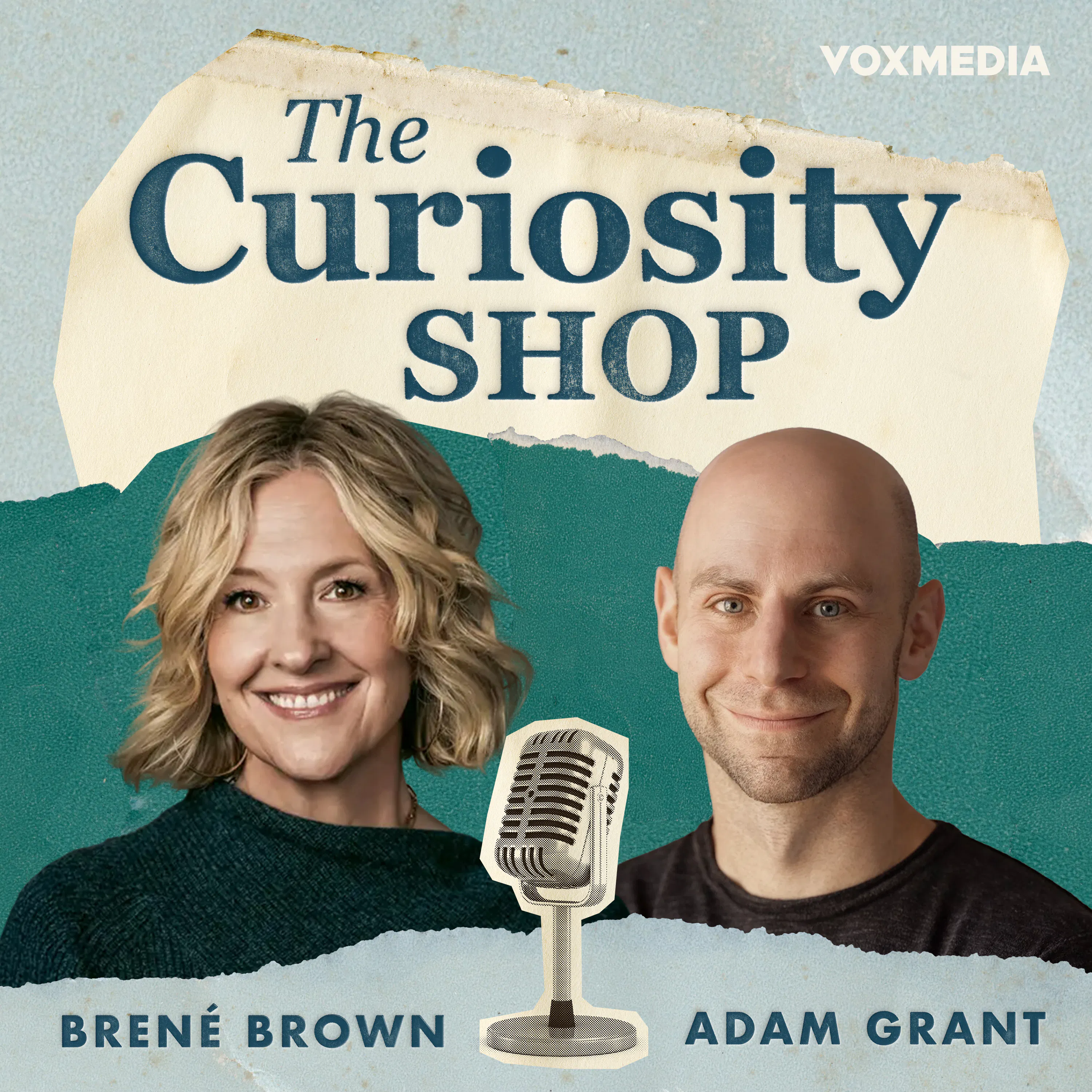
The Curiosity Shop with Brené Brown and Adam Grant
Building Integrity in the Age of Normalized Cheating
Research professor Brené Brown and organizational psychologist Adam Grant are partnering on a new weekly podcast grounded in an unflinching commitment to learning and unlearning. At a time when public discourse rewards certainty over inquiry, The Curiosity Shop features two of the world's most sought-after experts on connection, change, and leadership making the case for slowing down, asking better questions, and embracing informed complexity over easy answers. Bringing together their left and right brain sensibilities — she’s a qualitative researcher; he’s a quantitative researcher — they explore some of the defining questions of our time, unpack the research reshaping how we live, lead, and love, and dive deep into the ideas, evidence, and cultural moments intriguing them the most. New episodes drop every Thursday. Part of the Vox Media Podcast Network.
Show Notes
What happens to integrity when cheating becomes easier and the world seems to reward people for cutting corners? In this episode of The Curiosity Shop, Adam shares what happened when he discovered that students were planning to use AI to cheat on an exam. Brené and Adam move into a much larger conversation about honesty, character, and moral identity. Together, they explore when using AI is inherently cheating, why monitoring people isn’t enough to make them trustworthy, the difference between shame and adaptive guilt, and what research reveals about building a stronger moral compass. They also unpack why honor codes can sometimes backfire, how inconsistent accountability undermines trust, and what dimension of character we often overlook. Ultimately, Brené and Adam explore the difference between wanting to be seen as a good person and choosing to become the kind of person who does the right thing even when no one else is watching.
There’s Really Only One Way to Stop Students From Cheating – Adam Grant, August 26, 2026, The New York Times
Cheating: Why Students Do It and How We Can Help Them Stop – Donald McCabe, 2001, American Educator
Brené Brown: The Rage Bucket Theory – Trevor Noah, June 4, 2026, What Now? with Trevor Noah
Adam Grant Gives Trevor an Intellectual Wedgie – Trevor Noah, August 2024, What Now? with Trevor Noah
Pickleball Line Rules: Calling the Ball “In” or “Out” – PlayPickleball.com, July 31, 2024, YouTube
Cheating in the Age of Generative AI: A High School Survey Study of Cheating Behaviors Before and After the Release of ChatGPT – Lee et al., 2024, Computers and Education: Artificial Intelligence
Addressing Academic Dishonesty in Higher Education: A Systematic Review of Generative AI’s Impact – Sharma & Panja, 2025, Open Praxis
As Schools Reconsider Cursive, Research Homes in on Handwriting’s Brain Benefits – Jonathan Lambert, May 11, 2024, NPR
How Learning Handwriting Trains the Brain: The Science Behind the Cursive Wars – Mariana Lenharo, February 2, 2026, Nature
The Importance of Cursive Handwriting Over Typewriting for Learning in the Classroom – Ose Askvik et al., 2020, Frontiers in Psychology
Why Cursive Handwriting Is Good for Your Brain – Christopher Bergland, October 2, 2020, Psychology Today
The Effects of Handwriting Experience on Functional Brain Development in Pre-Literate Children – James & Engelhardt, 2012, Trends in Neuroscience and Education
How Handwriting Trains the Brain – Gwendolyn Bounds, October 5, 2010, The Wall Street Journal
The Self-Importance of Moral Identity – Aquino & Reed, 2002, Journal of Personality and Social Psychology
Does Moral Identity Effectively Predict Moral Behavior? A Meta-Analysis – Hertz & Krettenauer, 2016, Review of General Psychology
Competition and Cheating: Investigating the Role of Moral Awareness, Moral Identity, and Moral Elevation – Vadera & Pathki, 2021, Journal of Organizational Behavior
Moral Emotions and Moral Behavior – Tangney et al., 2007, Annual Review of Psychology
Shame and Guilt – Tangney & Dearing, 2002, Guilford Press
Shame, Guilt, and Depressive Symptoms: A Meta-Analytic Review – Kim et al., 2011, Psychological Bulletin
Shame v. Guilt – Brené Brown, January 14, 2013, brenebrown.com
Protecting Our Attention, Time and Humanity in a World That Won’t Slow Down – Brené Brown, August 20, 2026, The Curiosity Shop with Brené Brown and Adam Grant
Effectiveness of Ex Ante Honesty Oaths in Reducing Dishonesty Depends on Content – Zickfeld et al., 2025, Nature Human Behaviour
Committed Dishonesty: A Systematic Meta-Analysis of the Effect of Social Commitment on Dishonest Behavior – Zickfeld et al., 2024, Psychological Bulletin
Detecting and Preventing Cheating in Exams: Evidence From a Field Experiment – Cagala et al., 2024, Journal of Human Resources
The Honor Committee – University of Virginia, honor.virginia.edu
Effects of Honor Code Reminders on University Students’ Cheating in Unproctored Exams – Zhao et al., 2023, Contemporary Educational Psychology
Honor Codes and Other Contextual Influences on Academic Integrity: A Replication and Extension to Modified Honor Code Settings – McCabe et al., 2002, Research in Higher Education
Academic Dishonesty: Honor Codes and Other Contextual Influences – McCabe & Treviño, 1993, Journal of Higher Education
Bicentennial Analysis – UVA Honor Committee, 2019, University of Virginia
Culture Is Not the Problem. Tolerated Behaviour Is. – John Amaechi, February 15, 2026, Giant! with John Amaechi
Making a Pledge Can Encourage Honest Behavior—If the Wording Is Right – Simon Makin, Scientific American, February 26, 2025, Scientific American
"Do or do not. There is no try” - Yoda, The Empire Strikes Back, Screenplay by Leigh Brackett and Lawrence Kasdan, 1980, [Video] YouTube
I Solemnly Swear I’m Up to Good: A Megastudy Investigating the Effectiveness of Honesty Oaths on Curbing Dishonesty – Zickfeld et al., 2024, HAL Preprint
Trump Reports Over $1 Billion in Income From Crypto Ventures – TIME, June 30, 2026, TIME
Now Available: The President’s and Vice President’s Public Financial Disclosure Reports – U.S. Office of Government Ethics, 2026, U.S. Office of Government Ethics
Stop Trading on Congressional Knowledge Act of 2012 – U.S. Congress, 2012, Pub. L. No. 112-105
This Is Your Brain on Drugs – Partnership for a Drug-Free America, 1987, YouTube
Project D.A.R.E. Outcome Effectiveness Revisited – West & O’Neal, 2004, American Journal of Public Health
New Approaches to Youth Substance Misuse – American Psychological Association, March 2024, Monitor on Psychology
Beyond Pleasure and Pain – Higgins, 1997, American Psychologist
Self-Discrepancy: A Theory Relating Self and Affect – Higgins, 1987, Psychological Review
Possible Selves – Markus & Nurius, 1986, American Psychologist
Unwanted Identities: A Key Variable in Shame–Anger Links and Gender Differences in Shame – Ferguson et al., 2000, Sex Roles
Shame Resilience Theory: A Grounded Theory Study on Women and Shame – Brown, 2006, Families in Society
The BRAVING Inventory – Brené Brown, brenebrown.com
An Integrative Model of Organizational Trust – Mayer et al., 1995, Academy of Management Review
The Halo Effect: Evidence for Unconscious Alteration of Judgments – Nisbett & Wilson, 1977, Journal of Personality and Social Psychology
Integrity Is Choosing Courage Over Comfort – Brené Brown, brenebrown.com
The Self-Importance of Moral Identity – Aquino & Reed, 2002, Journal of Personality and Social Psychology
The Optics of Lying: How Pursuing an Honest Social Image Shapes Dishonest Behavior – Guzikevits & Choshen-Hillel, 2022, Current Opinion in Psychology
Atomic Habits: An Easy & Proven Way to Build Good Habits & Break Bad Ones – James Clear, 2018, Avery
Learn more about your ad choices. Visit podcastchoices.com/adchoices
This episode is not processed yet. Sign in to queue the transcript and make it useful for search and Q&A.
Sign in to queue transcript (1 credit)
Free to start
Skim the episode first,
Skim the episode first,
then decide if it is worth listening.
Sign up with Google in one click. 10 transcript credits included. No card needed.
Google sign-in · No credit card · 10 free transcript credits