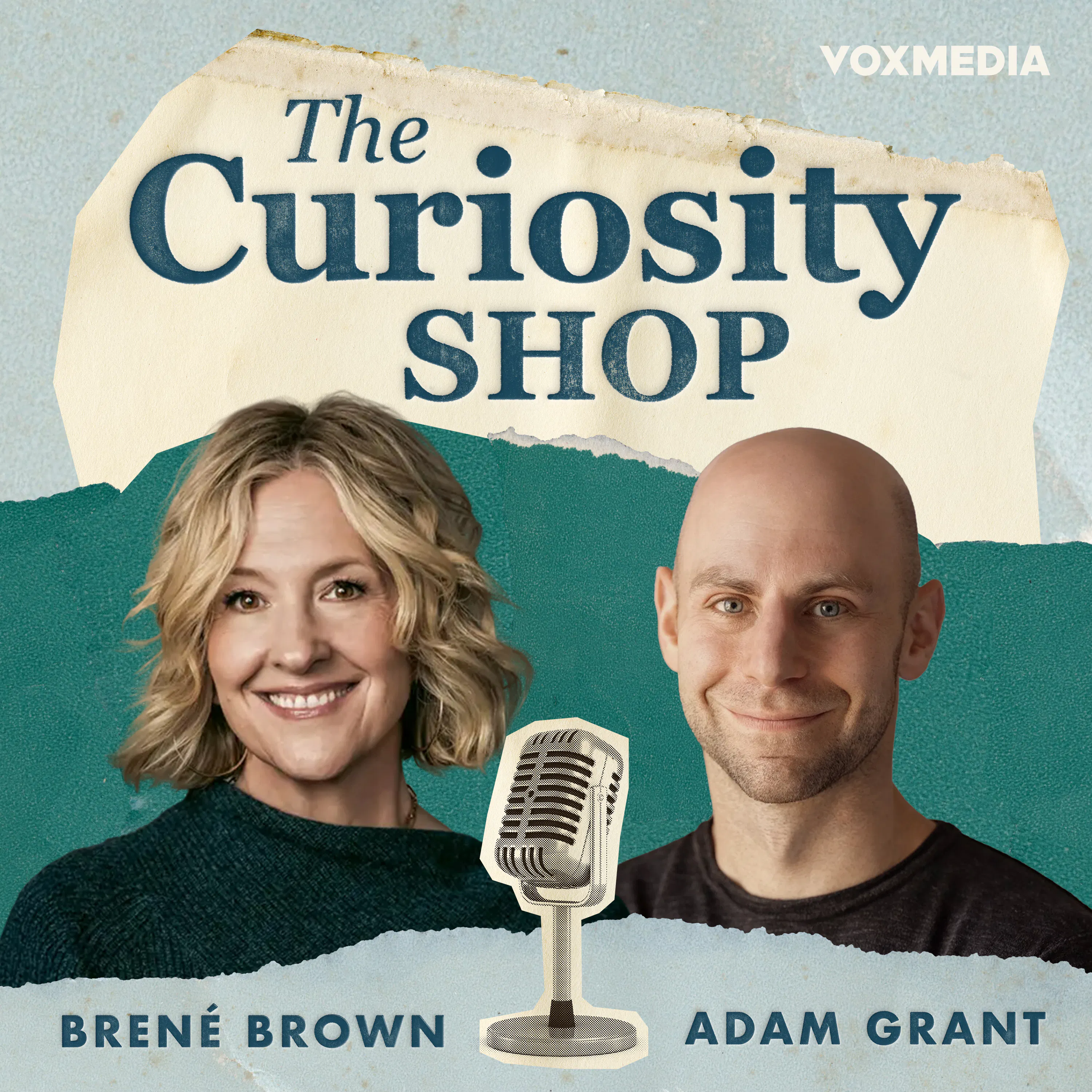
The Curiosity Shop with Brené Brown and Adam Grant
BS Disclaimers, Invisible Armies, and the Importance of the Words We Choose
Vox Media Podcast Network 1h 8m 4 months agoEN
Research professor Brené Brown and organizational psychologist Adam Grant are partnering on a new weekly podcast grounded in an unflinching commitment to learning and unlearning. At a time when public discourse rewards certainty over inquiry, The Curiosity Shop features two of the world's most sought-after experts on connection, change, and leadership making the case for slowing down, asking better questions, and embracing informed complexity over easy answers. Bringing together their left and right brain sensibilities — she’s a qualitative researcher; he’s a quantitative researcher — they explore some of the defining questions of our time, unpack the research reshaping how we live, lead, and love, and dive deep into the ideas, evidence, and cultural moments intriguing them the most. New episodes drop every Thursday. Part of the Vox Media Podcast Network.
Brené Brown and Adam Grant unpack two communication habits Brené dislikes: the “Invisible Army” and what she calls “bullshit disclaimers.” As they debate examples, they refine the difference between manipulative language and language that reflects care, psychological safety, and real responsibility.
1:08
Defining the Invisible Army
Brené opens by naming the “Invisible Army” as a communication move where someone says “we all think” or “we all feel” instead of speaking for themselves. She argues that this kind of vague collective language erodes trust because it hides behind unnamed others and avoids personal ownership.
Adam initially pushes back, saying group-based language can be a courageous survival strategy in low-psychological-safety environments. As they work through examples, they land on an important distinction: reporting what you are observing in a group is different from claiming to fully represent what everyone thinks or feels.
Brené objects to phrases like “we all think” and “we all believe” when no one is named
Adam argues that speaking on behalf of fearful coworkers can be an act of courage
They distinguish observation of group dynamics from falsely claiming a unified group voice
10:15
Psychological safety, groupthink, and precision
The conversation turns to why this distinction matters so much in fast-changing workplaces. Brené says that when people lack information, they make up stories, and imprecise “we” language can intensify anxiety and spread toxicity.
Adam connects this to research on speaking up at work, noting that managers respond better when concerns are seen as prosocial rather than self-serving. Together they agree that precise language matters because it signals what the speaker is actually responsible for, instead of shifting accountability onto an unnamed crowd.
Brené says imprecise collective language pours gasoline on uncertainty
Adam cites research showing supervisors value speaking up when it helps the group
They agree that saying “here’s what I’m observing” is more accountable than “we all think”
18:22
Anonymous feedback and when invisibility is warranted
After the ad break, Adam asks whether anonymous surveys are a kind of Invisible Army. Brené says no, because anonymous surveys still preserve one-to-one data from individuals rather than letting one person claim to speak for everyone.
They discuss how anonymity can be appropriate when power and equity cannot be discussed openly. Brené emphasizes that leaders should be honest about whether feedback is truly anonymous, while Adam suggests comparing direct feedback with anonymous survey results as a test of psychological safety.
Brené says anonymous surveys differ from an Invisible Army because they preserve individual input
She warns leaders not to promise anonymity unless it is real
Adam suggests gaps between direct and anonymous feedback reveal psychological safety problems
24:17
Calling out bullshit disclaimers
Brené introduces the second communication habit she hates: disclaimers like “I don’t mean to be critical, but” or “not to be rude, but.” She argues these phrases are attempts to say something harmful while escaping accountability for the impact.
Adam agrees and adds that these disclaimers also try to preempt the listener’s reaction. Through role-play, they explore how to interrupt these openings early, either by directly naming the accountability dodge or, in closer relationships, by responding with curiosity about why the speaker framed it that way.
Brené defines phrases like “not to be rude, but” as attempts to avoid accountability
Adam says these disclaimers often backfire by making listeners more defensive
They role-play ways to interrupt the disclaimer before the harmful comment lands
40:42
Responsibility versus accountability
As the role-play continues, the hosts realize both disliked communication habits share the same core problem: they blur responsibility and accountability. Adam defines responsibility as personal ownership over one’s actions, while accountability is having to answer to someone else for them.
Brené sharpens the practical takeaway: when she interrupts a disclaimer, she is asking the other person to take responsibility for what they are about to say and making clear that she will hold them accountable for it. They describe these interruptions as preemptive pauses rather than simple shutdowns.
Adam defines responsibility as personal and accountability as interpersonal
Brené says a disclaimer is not a free pass from being held accountable
They frame interruptions as a way to restore both responsibility and accountability
46:46
Useful hedges, gender, and identity
Adam then distinguishes manipulative disclaimers from hedges he sees as useful, such as “I might be wrong, but here’s a thought.” He cites research on “powerless speech,” arguing that in collaborative settings these phrases can signal openness, care, and willingness to consider others’ views.
Brené accepts that some hedges can be genuine, but strongly resists the idea that women and marginalized people should have to contort themselves to avoid threatening others. Their exchange broadens into a critique of workplaces and cultures that still judge people by gender and identity rather than by the quality of their ideas.
Adam defends hedges that communicate openness rather than excuse harm
Brené says she will not use softening language unless it genuinely reflects how she feels
They discuss how women and marginalized people are often judged differently for the same communication style
1:01:03
Negotiation, authenticity, and final takeaways
Adam shares research on salary negotiation showing that a relational framing can help women avoid backlash, and Brené responds by preferring direct, grounded language like “I think I’m worth it.” They discuss how authenticity itself can be persuasive when it is aligned with the speaker’s real style and confidence.
In closing, both summarize the episode as a call for nuance rather than blanket rules. They agree that language should be clear, caring, and aligned with genuine intent, and that the real test is whether a phrase reflects thoughtfulness and responsibility instead of manipulation.
Adam shares a negotiation example that improved salary recommendations for women
Brené emphasizes authenticity and grounded confidence over performative hedging
They conclude that the key tests are care, alignment, and responsibility
Show Notes
Tap timecodes to jump
Brené and Adam discuss the power — and peril — of the words we choose. They dive into two Machiavellian communication tools that often do more harm than good: the "Invisible Army" and "BS Disclaimers". Brené explains why leading with “we” or “but” often comes across as requesting permission to escape accountability, which ultimately sacrifices trust more than anything. Adam explores how these tools can sometimes serve as survival strategies in toxic cultures, leading to a conversation on psychological safety, groupthink, and why precision of language is more important than ever — especially in a world that still judges based on gender and identity.
You can find The Curiosity Shop on YouTube and Instagram (@thecuriosityshop).
Introduction
The Invisible Army
Speaking Up and Pluribus
‘But’ or Escaping Accountability?
Responsibility Versus Accountability
Judgment Based on Gender and Identity
Takeaways From Today’s Episode
Armored Versus Daring Leadership, Part 2 of 2 - Brené Brown, 2021, Dare to Lead (Podcast)
Getting credit for proactive behavior: Supervisor reactions depend on what you value and how you feel - Grant et al., 2009, Personnel Psychology
Plur1bus - Gilligan et al., 2025 - Present, Sony Pictures; Apple TV+ (TV series)
Does Performance Improve Following Multisource Feedback? A Theoretical Model, Meta-Analysis, and Review of Empirical Findings - Smither et al., 2005, Personnel Psychology
Feedback effectiveness: Can 360-degree appraisals be improved? - DeNisi et al., 2000, Academy of Management Perspectives
What Makes a 360-Degree Review Successful? -
Zenger and Folkman, 2020, Harvard Business Review
The bullshit asymmetry [sic]: the amount of energy needed to refute bullshit is an order of magnitude bigger - Brandolini, A., 2013, Twitter
The power of powerless speech: The effects of speech style and task interdependence on status conferral - Fragale, 2006, Organizational Behavior and Human Decision Processes
How Can Women Escape the Compensation Negotiation Dilemma? Relational Accounts Are One Answer - Bowles et al., 2013, Psychology of Women Quarterly
Likeable Badass: How Women Get the Success They Deserve - Fragale, 2024, Doubleday
Strong Ground: The Lessons of Daring Leadership, the Tenacity of Paradox, and the Wisdom of the Human Spirit - Brené Brown, 2025, Random House
Learn more about your ad choices. Visit podcastchoices.com/adchoices
Click-to-seek is unavailable — this episode appears to use dynamic ads, so the audio has changed since it was transcribed.
Transcript
0:00 Link copied!
What's up, y'all? I'm Skyler Diggins, seven time WNBA all star, Olympic gold medalist, and mom. And I'm Cassidy Hubbard, host and reporter for nearly twenty years covering the biggest names and stories in sports and mom. And this is and mom, a community for athletes, game changers, and moms of all kinds, dropping May 14. Tap in with us.Does anyone really know what goes on behind closed doors at the Supreme Court? Four years ago, I got a tip about the court, and I was not in the market to cover itwhatsoever.But this tip was about a secret influence campaign that had been carried out inside the court. As you know, the very idea of that is outrageous.I'm Preet Bharara. And this week, New York Times investigative journalist Jodi Cantor joins me to discuss her expose on the court's shadow docket. The episode is out now. Search and follow. Stay tuned with Preet wherever you get your podcasts.Welcome to the Curiosity Shop. A show from the Fox Media Podcast Network.
1:08 Link copied!
Hi, everyone. I'm Bren Brown.And I'm Adam Grant.And today, we're heretowatch Adam be really generous to me. I don't wanna be wrong on this topic today. I do not I cannot be wrong on this topic today. I am very vestedin my rightness.Wow. Okay. So you're already appealing to my core values and asking me to violate other values.You sort that shit out on your own, but I need to be right. You you you sort your value hierarchy over there. You you do that over there, but we're gonna talk abouttwoinsidiousMachiavelliancommunicationtoolsthat people use that are my least favorite in the whole world.I can't wait.But I should say, a wise friend once told me it's more important to get it right than to be right.Yeah. I call bullshit. But okay. SoI think we all knowthis first one. It isI I'm guilty of doing it, and I've been on the receiving end of it.And it's hard. It I I call it in my work the Invisible Army.Soin a work context,you're my boss.And I come up to you and I say, hey, Adam.We're all we're really exhausted.All of us are really tired of the way these priorities are shifting. We're really kind of sick of the pressure on us to domore with less, and we need a break.What's your first instinct there?
2:47 Link copied!
I wanna hear more.Okay. Let me let me tell you my first instinct.Let's turn this scenario around. You come to me and say, we're all exhausted. We're tired. We're we're the constant reprioritization'skilling us. We need a break. I'm gonna wanna look at you and say, you got a mouse in your pocket?Like, who's we?I I I cannot I I this Invisible Army, we all think, we all believe,we're all wondering.Like,come to mewith the eye.That's important enough.But for me, the invisible army of the people that are backing up your you know, and even in in in personal in the personal world.Listen. We're all we we were we're all really disappointed by this, or, you know, we all think you should talk to dad about this.This is so fascinating.This is exactly the kind of communication I teach.You teach people to say we?Absolutely.It's I mean, it signals that you're not selfish, that you're thinking about the good of the group,and that, you know, you're you're not raising something that's idiosyncratic.It's actually relevant to everyone. It's chicken shit.
3:59 Link copied!
I I I completely disagree.Unless you're willing to say to me, hey, Adam. Do you have a second?I sat down and spoke with Sabrina, Jose, and Jackaround what's going on,andwe kinda came up with some ideas. They were not able to meet with you, and but they said that I could talk to you about this. I mean,II think it's terrible. Like, I I literally, like, unless you have a critter in your pocket,I don't ever wanna hear your Invisible Army.Okay. I do. I wanna hear it all the time, but I don't I don't want it to be invisible. So I think what you just outlined is ideal in an environment with high psychological safety.That's that's the standard I'm aspiring to all the time.And anyone should be able to speakon behalf of the group, or ideally, everyone is speaking independently for themselves.In environments that lack psychological safety, if you're in a culture of fear, if you're in a culture of blame and shame,it's it's really risky to put yourself out there. And so if I'm the one to come to you and say, hey, I've heard a lot of people complaining about this, everyone else is afraid to tell you that for me, that's an act of courage. Right? Because I'm the messenger, and I might get shot. And that's so important that I'm willing to raise it anyway on behalf of the group. You did not say we once in your role model here.You said Oh, I'm not role modeling it. I'm explainingI'm just saying you said, I'm coming to you because here's what I'm hearing,and I think other people are concerned about it. So I wanted to let you know. That is not the Invisible Army.
5:33 Link copied!
Isn't it, though? No. Aren't they less visible? No. No. No. That is no.I think that's very different thanyou arming yourself with we all believe,we all think. You're saying, I'm observing this.I wanted to let you know about my observation.You're not representingyou're not you're not representing a delegationa fake delegation of fake ass people,becauseyou're you're not using the I statement.And so That's so interesting.Yeah. I think it I think this is really important because, literally,this Invisible Armyand and the way it plays out in family dynamicsis,you knowmy sisters and I talk about this all the time.Yeah. We all think you're being a real asshole here. Like, we who? I'm not gonna say because, you know, again, because you're an asshole.No. No. Like, if you think I'm being an asshole, I wanna hear that from you.But, again, unless you've got people in your pocket,and if you do, bring them out and thendeshrink them up to human size, and let's have a real adult conversation.I think the Invisible Army I think if you're teaching peopleto have the courageto say,there's something going on I think you should know about.I can't speak clearlyto people's comfort levels about coming to you, but here's something I'm seeing. I think it's getting in the way of the work we're doing,and I want to let you know about it. That's really respectful and thoughtful.If you're coming in a lead fascinating.Yeah. If you're leading with we all think,I I I I'm gonna wanna know who. And I'm gonna I'm gonna tell you whythis is suchwhy this is so important right now.The chain the velocityand volume of change right nowis so untenablethat there are no way there's no way people can keep up. We we can't keep everybody informed every second about the changes that are happening. In the absence of data, we make up stories.We just know that because we're a meaning making species.It does require psychological safety and good and daring really good daring leadership to say to your team, listen.I'll tell you what I know when I know.If you find yourself making up stories about what's happening,I want you to check them out with me.And you it's as simple as saying, hey. The story I'm making up right now is this.When you start using Invisible Armies,you are takingsmallcollections of fire and pouring gasoline on them.Andit creates such a toxic environment.We all believe. We all think.
8:26 Link copied!
So I have a different reaction to this. I think the two versions that you think are so different for me are almost identical.Andwhenso let let me let me actually just react to what you just said. I think when you say it creates a toxic environment to bring an invisible army,I what I see is people are doing that because they're in a toxic environment.That is a survival strategy.I'm coming to you and I'm saying, hey, I've been elected by a group of people who are too afraid to even give you their names.I'mspeaking up becauseI think you're gonna lose some really amazing people,and they're they're just too nervous to even put their, you know, their thoughts out there in a way that could damage their reputation or their relationship with you.And I know that it's it's ironic that that this is my reaction, not yours, because you're the one of the two of us who's normally more sensitive to to power differences. Right? And I just look at this, and I see I'm not like when when someone comes to you and they have the Invisible Army, yeah, I get I get that in some cases, you know, it's a strategy.And they're they're trying to bolster credibility,or they're trying to build up support for something that they know is a little self serving or, you know, kind of just a a personal ask.But that's not that's not how I see it unfold in most of the organizations I work with. I see people do this when they feel they have no other choice.And they say, okay. Look. This is a culture in whichpeople do not speak truth to power.And so this is the only way I can do that safely.
10:00 Link copied!
So this this is this is gonna maybe get too nuanced for the podcast where listeners and watchers are gonna be like, what's happening here? Again, I did not hear you, in your example, use an invisible army.I heard you Wait. So I heard you takeI heard you take full responsibilityfor what you were doing. I'm coming to you.Mhmm.I was elected by a group of people who are fearful about coming to youto let you know these things.That is very different than saying,we believe,we feel,we want.That that those are those are to meeven neuro linguisticallyvery different things.Okay. That's that's a helpful distinction. Now okay.So when you said Invisible Army originally,I was thinking, okay. You're objecting to any time I come and speak on behalf of a group, but you don't know who they are.And you're only objecting to a subset of that when I'm claiming to proxy a bunch of people who are hidden or unknown,and I'm not willing to even take ownership over the fact that I agree with them. Right.
11:18 Link copied!
Huge difference. Yeah. That is a big difference. I agree with that. Yeah. And I have to tell you that, like,when I think about this from an organizational perspectiveas a former union steward,that was my job.You know?But in in not until this very second sitting heredid I eventhinkabout the possibility that that's where this training came from.So as a union steward,I off I I had to be I neverI was trained to never say, we believe, we feel.Now I was trained to believe there's a problem on the floor. Yes.This is what's generating fear.It's getting in the way of work. It'screating burnout and call ins, call outs.So that's different because I'm taking responsibility for coming to you with a problem that I'm observing.I'm not pretending to representexactly how people feel and think and believe because I'm scare I'm scared that me believing and thinking and feeling it isn't enough.
12:29 Link copied!
Yes.Yeah. I've never I've yes.I have never noticed this distinction until you brought it up, and I I think it's important and right.You know, it reminds me of some some research I published years ago with Sharon Parker and Catherine Collins, where we studied how often people spoke up with concerns and suggestions.Mhmm. And we were interested in whether supervisorsvalued and appreciated it or whether they they tended to reject it. And what our data showed was that supervisorsliked it if you were doing it for prosocial reasons. If it seemed like you were trying to help the group and, you know, you were bringing up a a problem or a solution Yeah. That could benefit the whole team. But if supervisors perceived it as self serving rather than benevolent,they tended to dismiss it or even penalize it.And I've always then assumed that the we language is a way of signaling. Hey. This is this is a collectiveproblem,and I'm trying to help all of us.But I think you're right that if you do that in a way thatthat that essentially says,yeah, here is here there's a there's a group with a uniform opinion, and I'm gonna tell you I have read all their minds. I have captured all of their feelings and thoughts, and I'm gonna tell you everything that they want,that's not credible. That is manipulative. It'sSo thatthat's the thing that we're trying to avoid here in communication.
13:54 Link copied!
For me,well, to be honest with you, if you come in and say we all believe this or we all think this,I immediately don't trust you.I don't either. And it's not it's not just you. I now have doubts about your group too because if you're telling me the truth, best case scenario, then we're in the middle of groupthink. You got a bunch of people who are hive mind,and they're just clones of each other. They're not thinking independently. They're not coming to their own conclusions.They're sharing all of the same assumptions, and that means their thinking is faulty and flawed. So I don't I don't wanna listen to it even if you're being honest with me. Right. And so they just just listen forlisten forthe accountability shift here.I wanted to talk to you about something I'm observing in the team.And I'm not sure whether you're hearing this from other people or not, but I felt like I feel like it's an important thing to talk to you about. Here's what I'm seeing, and here's how it's disrupting work, and here'show it's creating a lot of anxiety and self doubt.This is my observation.Versus,I came in to tell you that we all think this,we're all feeling this, and we all believe this.
15:05 Link copied!
Yes.And if I come back to you and say, well, I don't understand why no. No. No. No. Don't get mad at me.No. No. I'm just saying that this is what everybody's thinking. This is what everybody's feeling.SoI thinkprecision,especially right now when shit is so hard, precision of languageas it relates to what you're representing and what you're accountable for isI was gonna say king, but is even more important that it's queen. Yes.Yes. Yes. Yes. Yes. Yes. Yes.Support for the show comes from Shopify.There's always something a little scary about starting your own business, and listeners of this show know that when you take on any endeavor,there will be bumps along that road and a lot of what ifs.But tools like Shopify can help settle those nerves and make things way less intimidating.Shopify is the commerce platform behind millions of businesses around the world and 10%of all ecommerce in The US from household names like Rare Beauty and SKIMS to brands just getting started.Shopify can help you build an online store that matches your brand's stylewith hundreds of ready to use templates.And whether you're uploading new products or trying to improve existing ones, Shopify can help accelerate your efficiency.Their AI tools can help you write product descriptions, page headlines,and even help enhance your product photography.Best yet, Shopify can be your commerce expert with world class expertise in everything from managing inventory to international shipping to processing returns and beyond.It's time to turn those what ifs intowith Shopify today.Sign up for your $1 per month trial today at shopify.com/curiosity.Go to shopify.com/curiosity.That's shopify.com/curiosity.
17:11 Link copied!
Hey. I'm Matt Bouchel, comedian, writer, and floating head you may or may not have seen on your FYP,and I'm starting a brand new podcast. Wait. Don't swipe away. It's called that sounds like a lot. I'm gonna start by breaking down whatever insanity is happening in the world, and then I'll sit down with a comedian or actor or writer or, honestly, anyone who responds to my DMs. This is not the place to get the news, but it is a place to feel a little bit better about it. You can watch on YouTube or listen wherever you get your podcast. That sounds like a lot, part of the Vox Media Podcast Network.This week on Network and Chill, I'm joined by Tank Sinatra, the meme king, with over 15,000,000 followers across Tank's good news, influencers in the wild, and his personal account. Tank is breaking down what the meme economy really is, how much a single sponsored post pays, why major brands are throwing serious money at jokes, and how meme culture, think Preparation H, starter packs, and a perfectly timed screenshot,is actually reshaping how we think about money and value. Get ready for a conversation that'll change the way you scroll, make you rethink what going viral is really worth,and prove that sometimes the most serious money moves are wrapped in the silliest of jokes. Listen wherever you get your podcasts or watch on youtube.com/You're Rich BFF.
18:22 Link copied!
Okay. I wanna I wanna talk about I think it sounds like we're gonna talk a lot about language today, which is great because you you and I are both word nerds. Yeah. Yeah. And I think I don't think enough people spend enough timechoosing their words carefully.Before before we we talk more about language, two things that jumped out at me on this. Number one, have you have have you been watching Pluribus?I can't.I tried. I wanted to. I justit's soit I go to bed at night, and I can't stop thinking about it. Like, I I can't. So but tell me tell me what you're seeing and watching.I'm obsessed with the whole concept.I'm only two episodes in, and I don't wanna spoil it for people who haven't seen it. But Okay. The the reaction I had watching it and seeing the way that a collective communicates as onegave me the same ick that yourwe all believe and we all think, and we all want gave me.And Oh, god. That's so interesting.
19:22 Link copied!
I think anybody who wants to understandviscerally why you're so bothered by one claiming to fully represent a whole, Like, just go watch two episodes of Pluribus. Done.Is I mean, I heard the acting's amazing. Is it it's justIt's it's beenstunning so far. But Wow. Okay. More more to watch. Maybe I'llit try again. Okay. What's the other thing you wanted to like, I love this I love this pop culture reference.Okay. The the the other one's the opposite of pop culture. But I was just thinking about this, you know, this how do you approach speaking up in a low versus high psychological safetyclimatequestion that we were talking about. And one of the questions I get asked a lot,I get I get tons of questions from managers and leaders about,like, should we do an anonymous survey of our people, or should we make the survey identified?And I've always been torn on this, and I'm curious to hear your take because,let me say this differently. I think an anonymous survey is an invisible army of sorts, but I don't think it's the kind you object to.
20:30 Link copied!
No. Because I think an anonymous surveyis individuals.There's not a there's not a representation.There's not a royal we there. So I think there's there's a representation, a one on one representation of data to person even if that person is de identifiedor anonymous.I I I think whenever I, of course, I get this question often as well.The thing that's the the first thing because I work from kind of the social work ethic of do no harm first. The first thing that always comes up for me ishow anonymous really is your anonymous survey. What's your sample size?How's it being reported? Is it tied to IP address?I would never commit to anonymityif it's not true anonymity,which really is about team size and all kinds of technology stuff.And I think for me, the answerto that question is always, what is your intention?You know, what are you trying to I have really mixed feelings about three sixties as well. I I there's I I've worked with one company out of 30 that does it well.You know? Yeah. It's hard. Yeah.They're hard,and they're flawed.And a flaweda a three sixty that has flawed design,flawed implementation,and flawed analysiscan just blow up a teamand a person.
21:59 Link copied!
Yeah. I've I've I've seen it happen. And,you know, thethe survey dilemma is interesting becauseI think on one level,I I want I wanna get to a point where people can say what they really think and put their names on it.The bigger the organization, the larger the team, the harder that is.And so one of the things I've yeah. I've sometimes hadleaders say, but, you know, I I create I create an environment where, you know, everyone can tell me the truth. My door is always open.You know, I'm I'm nonthreatening.I'm I'm inclusive.And sometimes I say, okay. Let's run the test.Ask people to give you direct feedback, and then we're gonna do an anonymous survey.And the larger the gap is between what people say to your face and what they say under the cover of secrecy,the more of a problem you have with psychological safety.And That's interesting. I think I think there's some there's something to be said for,like, let's let people be invisible,but let's not have one personclaim to be in charge of the army.
23:04 Link copied!
I I think that's I think that's exactly right. The biggest problem with the Invisible Army is thepurportedrepresentation.And so yeah.And I think the other thing that is interesting to me is ifIalways ask leaders if their door is openand they're receptive to feedback,then why are they asking me about doing an anonymous survey? I mean, so you you would know. The other thing is II am pro anonymity in any culture where there are not open conversations about power.So that's my litmus test. If you talk openly about power, if you talk openly about identity, if you talk about,you know, being the only anything in a room, if you if if those are just kind of normative cultural conversations,thenI'm more open to believingthatthe door is really open. If any conversation about power or equity is off limits,then, you know, I'd wear gloves when I completed the anonymous survey. You know? Just yeah.
24:10 Link copied!
That's a great point. Okay.Do you wanna go to the next one? And this I'm probably more loaded for bearon this one than even the first one. Wait. Why are you laughing?I I'm I'm just laughing becauseyou were the one who said a few episodes ago, like, we we shouldn't try to amplify tension. We should just, yeah, share and then see where the tension emerges. And here you are saying, I am loaded. I wanna be right. I I do wanna be right here because these are, like, these are the this oneisreally tough. SoI'll introduce this by saying I call these bullshit disclaimers.I know there are other terms in the in the research for them, but they're wrong. And then I wanna,let me just give you the first one.Anything that starts with look. I don't mean to be critical, but.I don't mean to be shitty, but. I hate to be rude, but.That's my least favorite one. Not to be rude, but Yeah. You're about to say something really inappropriate and offensive. Thank you for giving me a heads up. That's it. So let me translate those for you. I'm gonna be like the translator.
25:17 Link copied!
When someone says, I don't mean I don't mean to be critical, but what they're saying is, I'm getting ready to be very critical, and I do not wanna be held accountable for that behavior.When they say, hey. Listen. I don't mean to be shitty, Adam, but they're getting ready to be shitty, but they don't wanna be held accountable for being shitty.That this is the translation here. Here's here's the translation ring.Look. Not to be rude, buttranslation.I'm fixing to be really rude. I do not wanna be held accountable for it.That's what's happening here.Thoughts. These are hedges, soft openings. They're called a lot of things. I call them bullshit, but go ahead.I love it. I love it. Thesethese disclaimersthe the kinds of disclaimers that you're talking about, which are a different kind than the sort I wanna defendOkay. Great.Which is which is good news, I think.The kind that you're talking about areI never thought about it as escaping accountability.Oh, 100 But Ithink you're spot on.
26:19 Link copied!
I had a different way of thinking about why those bother me,which is when somebody says not to be rude, butI think that they're they're trying tothey're trying to preemptwhat they realize is a reasonable reactionand prevent you from having it.I yes. And ironically, think it has the opposite effect. Right? It it puts your guard up and leaves you to say, wait a minute.You're what why are you mentioning rudeness? Why are you saying not to be critical? You must have had a critical thought.And so I think it's it's counterproductiveregardless of,you know, regardless of what the person's intent is, that they're they're trying to escape accountability,it doesn't work because it draws your attention to the very thing that they're trying to minimize.Yes. Andit'sit is absolutelyait's an accountabilitytrapdoor.And I'm just realizing again in real time for the first time that the reason I do not like the Invisible Army or the bullshit disclaimeris for the same reason. It lacks accountability. They I I I just don't like the lack of accountability.So what what I teach people to do and I I mentor a lot of women.And I mentor a lot ofwomen who are first time college graduates,undergrad graduates that are getting PhDs,and they're on the receiving end of these things all the time. And so I thinkto combat the bullshit disclaimer,I like to go to I wanna share this with you. It's one of my favorite thing. It's it's Alberto Brandolini'sI love this. The bullshit asymmetryprinciple. Do you know it?
28:06 Link copied!
I love Brandolini'slaws. Go.Brandolini'sbullshit asymmetry principle. The amount of energy needed to refute bullshit is an order of magnitude bigger than to produce it.And so you have to do some workto to to really combat this. So let's do a role play. Are you game?I'm ready. Okay. I want you to say,look. I really don't wanna be critical, but like, you're starting a sentence.Renee, I don't wanna be critical, but Okay. Wait. Wait. Let me stop you there.I'm so glad that you don't wanna be critical. Do you wanna take a few minutes to find a more productiveway to share your feedback and coaching with me? Because I'm really I'm really grateful for your commitment to not be critical.Wait. Are you saying we're not allowed to be critical?I thought we wanted to have high standards and be discerning.Oh, no. We can be discerning, and we can I love the coaching, and I love the feedback?But when you start a sentence with, I don't mean to be critical, what I hear is I'm going to be critical. I don't wanna be accountable for the behavior.So I'm glad you're making a commitment to not do that.Let's try it again.Like, this is one of my favorites. I actually took thisfrom a real life experience.I'm not trying to tear you down.Butso you try you try the intervention here. Look, Adam.I'm not trying to tear you down.
29:32 Link copied!
But Oh.Oh, wait.Bren, it's really surprising to me that you would even think that I would think that you're trying to tear me down.We we have a strong relationship. I know we care about each other.Why would tearing me down even cross your mind?Ilove this. But, okay, you get bonus points. A plus.This is what I mean. Like, you have to have a little tolerance for interrupting, which I normally don't love.But I think if you want tohold people accountable,you have to stop them right there before they get to the shitty part and say, great. I appreciate the commitment. Eitherdo you need more time to find a better, more productive way to give me some coaching or feedback? Or wow. What you just did was great. I'm gonna add it to my repertoire. What did you like about it so I can learn?Oh, wait.You kinda stopped me, which you have to do. And then you said,I I'm surprised that tearing me down even came up for you. I I would not expect that becausewe care for each other, and we give each other tough feedback sometimes, but in a caring way.How did you get to tearing me down?Like,again, it's an accountability shift.
30:46 Link copied!
Yeah.Yeah. It's asking you to be accountable for the phrase that you put on the table and the sentiment behind it. It's alsoI mean,what I was what I was trying to do there was just welcome you to the Curiosity Shop.Like, I amI'm so curious about why you would approach me from a tearing down lens.And you should be curious about that too, I hope.That's really interesting.I'm coming from the shut the fuck up lens,which is different than the welcome to the curiosityshop lens.Okay. And why why is that why is that different? I thinkWhy is what different?Why do we approach this differently?Okay. We're trying to get to the same point. We're trying to accomplish the same thing. We have different styles.I don't know. Maybe not. I'mtrying to say,woah.Take accountability for what you're going to say,and don't try to squirm out of accountability before you even say it.And I feel like you're trying to say, woah.I'm surprised to hear that language from you.I'm curious where it's coming from.
32:00 Link copied!
Mhmm.I I I don't knowthat we are coming from this. You're coming from curiosity. I'm coming from accountability.I think there places maybe.Maybe.But do we wanna land the person at the same place? I wanna land it atthe other person doing some questioning and rethinking ofwhat their intentions were and what kind of relationship we have and saying, Ireally I really ought to approachboth my goals and my communication style a little more thoughtfully.Okay. That's really wild because let me tell you what happened when I was like, I'm gonna add that to my repertoire. Let me tell you what immediately happened in my my back processor.This is so wild that this is happening in real time.What happened in my back processor when I said I'm gonna add that to mylist of things to dois the people I thought about immediately were people I care about and with whom I have a relationship with.So I thinkthat if I care about you,what you're sayingis better curiosity and connection and care is better than if I don't really know you.And, I mean, I've had people stand up in a Q and A at an event and be like, listen. I don't mean to drag you in front of everybody, but I'm like, woah. Woah. Woah. Woah. Great.I wanna hear what you have to say.But if you don't wanna drag me, then think of a different way to say it.
33:34 Link copied!
Yeah.Yeah. Okay. So our approaches are yeah. I was thinking about this in the context of an established relationship.Right. So I think in that Yeah. To say, woah. Woah. Great. Where where did tear me down come from?Or I don't mean to be rude. Woah. Before you even go,I don't experience feedback from youas rude.I I mostly experience it as helpful or at least coming from a place of concern or curiosity.What aboutthis is feeling likedifferent different for you or, like, it's going to be hard or rude?Yeah. Yeah. That's really good. But that's that means you can say what that is. Let me tell you what you let me tell you the difference between yours and mine.To me, yourstelegraphscare, connection, and relationship,and mine telegraphs,your disclaimer will not get you out of accountability with me. I don't know you.I don't know what you're getting ready to say, but just know that that's not going to work.Two different populations.
34:39 Link copied!
Different populations,but also different speakers.I I wonder I I'm just thinking about gender stereotypes here. It will surprise no one that women have to work harder to prove their competence than men.And so you asserting some degree of strength and authority,which gets taken for granted when I speak as a man much more so,is that is that partially gendered?I was with you on the gendered part till you got to to you got to the why the gendered about me do me doing this as a as a as a show of confidence or confidence even.I think the gender part that that started to ring true for me waspermissionto be rude, critical, tear people down, and tear people apart without being held accountable for it.That seems very male to me today.Yeah.And so yeah. And Particularly to do that to a woman. To a woman. Right. With yeah. And so but other power differentials, I think, exist as well. And so there's other relationships where that that plays out. I thinkthe difference for me really comes down to, and it's quite clear in my mind, to be honest,investment.WhenI wanna get under something and get curious about it,I want what, like, what in coaching, wouldcall channel three communication,listening for connection.Not listening just to understand or listening to respond. Yeah. But real channel three listening for care and connection.I'm not even on channel three if I don't know you.Right. If I know you,I might respond with, woah.I don't know what's gonna come next, but the tearing down is not something we usually do together.I think that I because I I wouldn'tI was imagining if one of my kids said to me I would have a hard time imagining because I don't I don't think we talk like this to each other in our family. But if one of my kids said, look, mom, I don't mean to be rude, butI don't imagine saying, hey. Then do you need more time to figure out something, you know, a way to do this where it's that's not rude? I would imagine saying, woah.Before you even go there,I don't ever experience your feedback to me as rude. Yeah.The then I think I would say with one of my I I might say, do you want more time to think about what we're gonna talk about or something?But I would be on channel three communication.
37:05 Link copied!
And if you're if you're dealing with a stranger or somebody you don't have a meaningful relationship with, it seemed like your motivation was more to neutralize it.You're you're gonna you're gonna almost like you were almost preemptively putting the person in their placeor shutting down their tactic.No?It wasn't neutralizing.It waswhat's a nice way to say proceed with caution?Like, no. Really. Oh, so you're waving a red flag.I'm waving a flag that said,I don't know what's coming next, but just because you started this waydoes not mean I'm not going to hold you accountable for the behavior. So let me just let me get let me issue a preemptive caution herethat I recognize your disclaimer.I understand that the energy it's gonna take me to intervene right now is an order of magnitude greater than the bullshit you just created with your disclaimer.SoYes. Be thoughtful.
38:06 Link copied!
So it's a it's bit of a wake up call.You are treading on thin ice.I'll wait until you get to the right one. Keep going. Like, what what are I'm other trying to I'm trying to findI I I'm I'm trying to well,I'm I'm cyclingthrough the different things I thought as you were saying that. So another one was,no, that's not quite right either.What what let's do another one, actually. And I'm gonna I'm gonna try to pay attention to my reaction real time. Okay.Okay. I've got one for you. Okay.Okay.Bren. Yeah. I've been biting my tongue on this for a whileand justno offense.But Okay. Woah. Woah. Woah.When you say no offensebefore you even start,I get genuinely concernedthat you're looking for permission to say something offensive.And our relationship really means a lot to me.So if that's what's coming next,I wonderI'd love to slow down a little bitand get underneath what's going on before we get there. Because Iwhen I hear no offense, I usually prep for getting offended, and I don't wantus to do that to each other.
39:27 Link copied!
Okay. Okay. Light bulb. Okay. No worries. But this is mychannel three care curiosity.K. Yeah. Yeah. I felt I felt that strongly, but I alsoI felt something that I think is consistent across the different contexts,which isyou are actually shifting the responsibility back to me. The way that I'm bringing this up Yes. Yes. Yes. Yes.Okay. Good. Okay. We got it. So the way that I was bringing this up, no offense, but I'macting likeyou are gonna unreasonablelikeyou are being unreasonable in taking offense. Yes. But I but I know you're the kind of person who might be delicate and sensitive. And so I'm putting it out there saying, hey, hey, don't be that person. I'm not doing anything wrong. It's you. And so No. You need to adjust to what I'm about to say. Nope.No.Not you are a delicate and sensitive person.I might be ready. I'm I'm getting ready to be a dick. That's how I would see it. Like, I'm get I I'm giving myself permission.Yes. No. No. No. We're yeah. Because because I'm giving myself permissionto not be thoughtfulby telling you to not take offense.Therefore, I don't have to do any work on my side to make sure that I'm giving you feedback or coaching in a non offensive way.
40:51 Link copied!
Yes.Yeah. I I I think we're we're actually saying the same thing here. Okay. Great. What I'm what I'mI'm trying to drive at isIknow that what I'm going to say might be offensive.But instead of taking ownership over that and trying to make sure it's not offensive or it's presented in a way that shows care or a desire to help Yes. I am offloadingthat responsibility to you and leaving you wondering,like, whywhy would you say this?Are you like, do you think I'm the kind of person who takes offense easily?Yes. Exactly.Andand when when you cut it off and say, hey. Wait a minute. Why why don't you pause and think about this for a second? You're putting that responsibility back in my hands where it belongs. Okay. This is exactlyeverything.Thisis It's something. It's definitely something. It's everything. It'swe we were using the word accountability as aswhat both of these communicationtoolshave in common,the Invisible Army. And but it's also about responsibility.When you come into my office and say, I'm observing something that I wanna share with youbecause I have concerns,then you are taking responsibility for what you're getting ready to lay out on my desk.Yes. When you when when someone says, hey, let's pause for a second then.When you say don't be I don't want you to be offended.I'm wondering if we can, you know, if we can justget ahead of that.I am shiftinghow do you think differently about responsibility and accountability?I've never thought about it really before.
42:35 Link copied!
I think responsibilityiswell, okay. I'm just I'm just thinking about the research on this. Responsibilityisa sense that it's a it's a sense of ownership that I take overmy actionsOkay. Or over a decision.Whereas accountabilityis mehaving to justify my actions to you.Okay. I'm not tracking. Say it again.So responsibility is personal,and accountability is interpersonal.Okay. Got it. Okay. Yeah. Yeah. Yeah. So responsibility is something I can take, but you can hold me accountable.Got it. Okay. That's super helpful. He's justify, haveexplain, and answer to you as opposed to when I'm responsible,I'm answering to myself.God, then why don't we talk about radical responsibility instead of radical accountability?Because we don't trust people to uphold their commitments to themselves. We think that they need to be held accountable by others.So But a lot of people think that. Yeah. Yeah. It's interesting.
43:39 Link copied!
It's like a whole another podcast, I think. It might be. Yeah.Sowhen soit's interestingbecause I'm gonna get really nuanced here, but I think it's really important. I mean, I'm telling you, if if you if you unless you are an island, if you have a partner,if you're a parent, if you have children, if you have friends, I think this is an important conversation.Becausewhen I stop you, when you say, look, I don't mean to tear you down here, Bren, but and I stop you,I think two things are happening.And I say, woah. Woah. Woah.Then let's stop before that even potentiallycould happen.There's two things happening there, Adam. One isI need youbefore you start to take responsibility for what you're going to say.AndI will hold you accountable for what you say.Ding. Ding. Ding. Ding. Jackpot.Yes. Do know what I mean? You're asking me to take responsibility, and you are making it clear up front that if I don't, you are gonna hold me accountable. Yeah. That's exactly right.
44:43 Link copied!
Yeah. So k. Let's k. Let's keep that in mind. Let's like, let's hold that in mind.Sowhat what these preemptivepausesI like that better than interruptionswhen people are using these bullshit disclaimers.What they're doing is a combination of responsibilityand accountability.So Yes. Let's try it again.And I don't really know you.And so I I don't know that I'm gonna be on channel three communication with you looking for care and connection. I'm just going toI'm just gonna probably say something. So why don't you say to me, look.I don't mean to be shitty about this.So why don't you try that with me?I have to I have to use one that I would actually Okay. Yeah. Yeah. You're saying. Yeah.That's what I would say.I I I don't like to think about myself as someone who would ever be shitty. So,that might be wishful thinking. But here we go.Bren. Yeah. I don't mean to sound like a jerk here, but it's really important to Okay. Okay. Let me can I just stop you there?
45:46 Link copied!
You already did? Yeah. Itit worries me when you say that you don't mean to sound like a jerk because I don't experience you as a jerk.I can't do the other one with you because I I'm always on channel three communication with you because we're friends. So so I would just probably say,I when you say you don't mean to sound like a jerk,I immediately kinda get defensive.And I also am curious about we don't talk to each other like that.Sodo you wanna take a pause and figure out another way that would be jerk proof?Yeah.So there it is. Like, I need you to take responsibility for what you're going to say. Yeah. And to say, I don't mean to sound like a jerk is not enough responsibility.Yes.And if you are indeed a jerk to me, I will hold you accountable for it. And your disclaimeris not a get out of jerk,you know,free card.
46:46 Link copied!
Okay. So thisthis is a this is a big moment for me.Because Me too. This clarifieswhyI likeanother flavor of disclaimer and hedge.Okay.The kind that I like are the opposite of making excuses.They are I love disclaimers and hedgesthat show interpersonal sensitivity,as opposed to showing a lack of sensitivity and a lack of concern and care for others.Socan I walk you through some examples of the ones that I find myself advising?I amon the edge of my chair with bated breath, and I'm a little nervous. Go ahead. Okay.Bren, I might be wrong,buthere's a thought.Bren, Ithinkthismight be true, but I'm not 100% sure.What do you think?I love those. Do you wanna react, or you want me to tell you why the science has taught me to love themfirst?
47:51 Link copied!
Oh, you could tell me. I I'm I'm torn. I'm mixed, but I wanna hear about the science. And I'm I I wanna hear about the science, and then I'llwalk through it with you. Go ahead.Okay. Tell me about the science.I'm curious. I'm very curious.Good.Good. Okay. Sothere'sa solid body of evidence showing that if we are interdependent,if we're collaborating,if we're playing basketball as opposed to doing gymnastics,to use one of our new favorite analogies,that you care as much about whether I'm interested in your opinionas you do about whether my opinions are right.And you're you're vetting me on on care, not just competence.And in those situations, it's really importantfor me to show that I'mI'm willing to consider your view, that I'm not just locked into my view.I I have to balance assertiveness and openness.So Alison Fragail calls this the power of powerless speech.And she finds that when when people are evaluating a potential teammate, and I imagine this is true also when they're looking at a a possible partner on on a first date,thatthey they look at these disclaimers and hedges and think, okay, this person is not gonna be a bull in a china shop.They're not gonna dominate every decision. They're actually gonna be receptiveto what I have to say.Andthe the research I've read on this in the workplace suggests thatif your boss is easily threatened,it's better to frame your suggestion as a question.Like, here's an idea. What do you think of this? As opposed to, here's an idea. You should adopt this.And if you wanna influence someone who has more power than you, instead of just telling them what you're gonna do, it's more effective to seek their advice and say, hey. You know, I'm I'm kinda torn. What direction would you recommend?And I think I find that really compelling.And there's, I think, a bunch of evidence suggesting that, unfortunately, we live in a world where these strategies are especially important for women,because women aremore likely to threaten male audiences in particular,and using so called weak language is actually a source of surprising strength,which we can go into more. But I have said enough things.
50:13 Link copied!
Well, what's the top of mind right now for me is fuck that.Rightfully so. That's why I said unfortunately.Yeah.That unfortunately doesn't cover it. Butherehere is wherehere is where I get worried.Well, first of all, let me just say this.For the record, as my partner and collaborator in this podcast,I am not gonna do that.I am I am zerochance am I gonna do thatifit does not accuratelyreflect Yes. My genuine sentiment.Yes.Endorse. Other otherwise,you know, this is like the gauntlet of talk this is the gauntlet of bullshit masculinityis thatif I'm direct,I'm an aggressive bitch.If I hedge and use disclaimers,then I'm wishy washy and lack executive presence. Like, so I'm gonna pickthe onethat makes meenables me to sleep at night. And soandthis I'm like, I'm really having to stay in my skin. I'm I'm working really hard to not lose my mind right now. Butit's not it would not be unlike me. And I think you could you could you know, starting a business together with a partner like you and I have done, which a podcast is a business,is not easy. And we've had really hard talks, really hard rumbles. We've talked about having to do repair with each other.It's not gonna be unusual for me to genuinely say to you,I'm not sure if this is a the best idea that I've ever had or the worst thing I've ever thought, and then I'm scared. I'm not even sure what's driving it, but here's what I'm wondering if we should consider doing.That that I'm gonna say that to you because it genuinely reflects where I am.Butthe days of me contorting myselfinto a hedgylittle disclaimer,I have an idea,and I'm wondering if you think it's a good idea because it would be so cute if you thought it was a good idea. Fuck that. I'm not doing that.
52:35 Link copied!
Oh, no. Yeah. I don't I don't ever wanna hear that from anyone. Yeah. Especially from women. But anybody. But anybody. Yeah. And soI thinkit really does point toit really does point toit it really almost makes me wanna cry. I'm gonna just be really honest with you. It's like I really haven't to fight back tears because it's just not me. It's, you know, black folks and brown folks and disabled folks and queer folks and people who, you know,this is the best idea you're ever gonna hear, dude, and I'm gonna make you think it's yours so I don't get in trouble so you're not threatened by, you know, my excellenceand, you know, you're winning mediocrity.It it's justit's really hard. And so what I would say isI think it's interesting to read the comments on our podcast. So some people listen to it who are not into the leadership work that we do and not even into thinking about work. They're thinking about this for their their lives.I think I would saywhen I genuinely feel curious,I wanna be in relationships with people where I'm not dinged for saying, look. I'm not sure, but here's what I'm thinking.
53:46 Link copied!
Yes.And I wanna be equally in relationshipswhere I'm like,shit.I think I figured this out last night.This is what I think we should do.Then I want people to be like, go.Go. I love this for you. Shine the light. Yes. I love it. And soif you can't be both in your power and in your vulnerabilityin your personal life with people,it's a reevaluationmarker for me.And at work,I just want you to know that that's not always true for all of us. I I mean, I think probably I take this so personally because I just think as a, you know, a newly minted assistant professor, this was my whole life in committees. Yeah. You know? Yeah. I'm wondering I mean, I'm not sure, but I'm thinking we should you know you know, this is the reality, and this is whyequity matters. This is why feminism matters.This is why representationmatters.And this is the problem, I think, sometimes with research.It will tell usthrough a scientific modelwhat's effectiveYeah. But not always shine a light onwhy we have to do shit like that to be effective.
55:03 Link copied!
Yeah.Beautifullysaid with power and vulnerability.AndI I would say it tells us what's effective, but not always what's right. Oh, god. Yes.It also tells us what's effective in a one shot situation,butrarely addresses the question of, are we then just reinforcing the stereotypeand failing to shatter it?And I think the more times you break the stereotypeby saying,this is a really good idea,the better, right? Because you are modeling a different way of communicating and legitimating That's right.Andas I listen to your reactions on this, I thinkit strikes me that two things can be true simultaneously here. One is thatwe've just got to stop evaluatingpeopleontheir styles of communicationand start evaluating them on the quality of their ideas and the thought and care they put into presenting them. I I think that's right. I think that's exactly right. Unfortunately,we're not there yet. We sadly live in a world where people still get judged on the group they belong to and the identity they hold. And given that,I I'm I'm still committed to figuring out, okay, what is effective for somebody who might might be threateningto, you know, a majority group memberor who might be injust a a tough position. How do they communicate? And so I I wanna get your reaction to a specific example.Thisis Hannah Riley Bowles and Linda Babcock.It's one of their experiments on relational accounts. You know, the work onwomen negotiating salaries.Sotheytried to put togetheran example of something that you could say that I think shows both strength and vulnerability.And I like it. Ihave a hunch that you have some ways to improve it. Sohere is the line that boostedsalary recommendations for women did not matter for men in one of their experiments.The line I should say the line is part of a paragraph, but this is the line that stood out for me.The line goes like this.I don't know how typical it is for people at my level to negotiate,but I'm hopeful you'll see my skill at negotiating as something important that I bring to the job. I love it.There's a disclaimer. Right? I I'm actually not sure if this is appropriate,but this is something I'm really good at. And guess what? I'm gonna be negotiating on your behalf if you hire me or if you give me a raise. And this skill that you could otherwise perceive as as hurting you because I'm asking you for more money, this is actually gonna work to your benefit.
57:46 Link copied!
Yeah. And I don't think I'mdid you say this, did I know this already? Did men did not get dinged on that.Correct. Yeah. Yeah. Yeah. And so I II don't know because to me,what my my my read is I I don't really I don't reallycareif this is normative or not.I'm gonna I'm gonna negotiate this with you because I think it's a good skill that I have, and I'd like for you to see it. And I'd like more money.And so,so Oh, I like I like I like how candidly you did that. The you just put it out there. Yeah. I mean, that that's it. I think I'm worth more. And so so I think thatWoah. Pause on that for a second. Pause on that. Yeah. Yeah. Just I mean, we're we're talking about about these micro patterns of communication.Yeah.ThinkI mean, the word that comes to mind is authenticity. But Right. You said it you said it so matter of fact. I think I'm worth it.Thatthere there's something so influential about that thatit doesn't come through when somebody says, I'm gonna make the case to you that I'm worth it. I'm worth it for the following seven reasons,where it starts to feel overexplained and over justified. And you're just saying, I think I'm worth it, whichdoesn't require me to to put up my guardand argue with you.And it also it it just conveys so much confidence on your part. Like, you don't have any doubt. I'm worth it.Yeah. And I'm also That is such an effective way to communicate.
59:20 Link copied!
Yeah. For me, I I also think, though, it's it's really tough too,becauseI haveit's personality aligned for me. Like, I I'm I'm I'm I'm not always funny, but I'm quick witted. It might be bad, but I, you know, II have a personality that that suits. And so I know what style is best for me.Would it work for everyone? I'm not sure. Have I heard it more recently in our hiring over the last two or three years?A 100%.Do I love it in people? 100%.And soI because they will be representing me in situations where I will need to see that level of grounded confidence.So I think that and the other thing is thatin terms ofthe humanity up front, the humanity the humanity and the power, the vulnerability and the confidence, those things living together,I think curiosityis the key there. I Iwe talked about this the other day where we were talking about,oh, I was I was joking about the fact that I didn't know whether someone's in a car service for me for a job, and I was like, should I tip this person? I because I came up you know, in addition to being a union steward of my colorful past, I was a bartender and waiter for six years.And so I just said, you know what? I know this seems really weird, but how does tipping work with y'all? Becauseit's important to me to get it right. And so if you've tipped, I wanna know. But if you haven't been tipped, I wanna know. And the driver literally turned around at the light and said,it's so thoughtful that you would ask me that.Most people are so anxious to talk about money and things like that that they just wouldn't even ask.So they would eitherthey just probably wouldn't do anything. I'm like, yeah. I just don't know how it works. Yeah.And he he's like, well, this this this is how it works.
1:01:12 Link copied!
This is this is almost like oh, sorry. Go ahead. No. And what I learned wasthere is a minimal tip included,but it's not a living wage kind of tip.Andbut a a regular normal tip would be too much because there is a small percentage included.So he said if you're if you're driving with one of our drivers in this driving service,this is really helpful.I was like, man, thanks. That's so helpful.It would have never occurred to me to go to the source and just ask.It's it's almost like asking for directions as a as a man driving.No. No. I I should just know. I should be able to figure it out. And what I would do instead, if I couldn't, is I ask somebody else who's taking the car service, but I don't go directly to the driver. And I loved how you did that.We're we're we're probably at time here. So maybe moving forward, wrap up. Yeah. Yeah. So twohigh level I don't know how high level these are, actually. Two reactions,just stepping back a little bit.One is,I think my big worry aroundpeoplejust objectingacross the board to disclaimersis, you know, I hear a lot of people just pounce on so called weak language.And they say, you gotta edit all the disclaimers and hedges out of your comments and meetings, out of your speeches, out of the way that you talk to your partner.And I think that's a mistake. I don't think we should be judging language as strong or weak. I think what we should be conveying is that language should be clear,and it should be caring, ideally.AndAlison Forgell's book, Likable Badass, is such a goodencapsulationof how to do that effectively.And I think you actually modeled some of what she recommends in the book, in the way that you asked for your raise. So that was my first reaction.The other thing that I'm just left thinking about is,I think weno.Maybe not.
1:03:14 Link copied!
Oh, I love this. I love your thinking in real time. It's like down downloading downloading learnings right now. Buffering. It's buffering.I love it. The little wheel is spinning, and I changed my mind about where I was gonna land. But, no, I'm going back to the beginning where you talked about Invisible Armies and Bullshit Disclaimers.And I think striving to make our armies as visible as possibleand making sure our disclaimersare not bullshit,but they're heartfelt,issomething we can check before we use them.As opposed to having this Yeah. Like, youcan't ever have an invisible army. You can't ever have a disclaimer. WhatI took out of this conversation is how nuanced that is and how there's a time and a place for each of those. And there are also ways in which they can be used manipulativelyand counterproductively.I think that's aI think that representsmy takeaways. I I really had some big takeaways from our conversation today.Personal takeaway for me that was hard ishow easily I get hooked when people do not takeresponsibilityfor the language they use and the impact it has on other people.The second one is how frustrated I getwhenI have to do the lift of holding people accountablefor not taking responsibility.There's a theme here. Three,Ithinka hedge,a disclaimer,representationof other people's opinions. I'm not gonna call them an Invisible Army because I have such a negative connotation around that, but just the representation of what you're seeing in other people.I thinkfor me, the bottom line iscare,thoughtfulness,andis it aligned with how you really feel?You can never make something effectivethat's manipulativeand not aligned with, really, I think, what you're sensing or feeling. I think that's very, very difficult because I think above all else, no matter what we're hearing,we are doing an authenticity check on people all the time.And I just think the emotional baggage from a lot of the work that women have to do aboutreally often making people feel good about their own mediocrity while making ourselves smallis kills us. And so literally and spiritually and morally in every other way. So I think that's that was a big learning. I love the conversation. I I appreciate it. AndI don't always love it when you pump the brakes,but I did not find myself flying through the windshield on this one. I did I I it was more of that thing that your mom and dad did when you were little and you were riding in the front seat where they just kinda put their arm out on the on the brake pump. I I do thinkmy own argument would say it's not an all or nothing.It's about alignment and nuance and care. And I just wanna say for people listening,don't think that this came easy to me if I have the right words. I practice every hard conversation I'm gonna have with someone with a coach.I you know, I've been working on this in a lot of different ways, therapy, coaching, practice, discipline for twenty years. And so the careful use of languageisit's a practice.
1:06:43 Link copied!
Would you agree? Realize I I didn't even realize I pumped on the brakes.Yeah. Because, I mean, the name yeah.Because of the name of this this thissubchapter in Strong Ground is beware of Invisible Armies and bullshit disclaimers.Like, it isit's it's prettysweeping.Well, I don't think it's sweeping at all. I think thatI think the invisible modifier,we clarified what Yes. That's true. Acceptable versus unacceptable invisibility is. Right? But you've already had a modify in modifier in there. And then bullshit disclaimers. I'm I'm defending non bullshit disclaimers, and you are too. That's it. Let's go. That was fun. See you next time.The Curiosity Shop is produced by Bren Brown Education and Research Group and Granted Productions.You can subscribe to The Curiosity Shop on YouTube or follow in your favorite podcast app. We're part of the Vox Media Podcast Network. Discover more award winning shows at podcast.voxmedia.com.
Free to start
Skim the episode first, then decide if it is worth listening.
Sign up with Google in one click. 10 transcript credits included. No card needed.