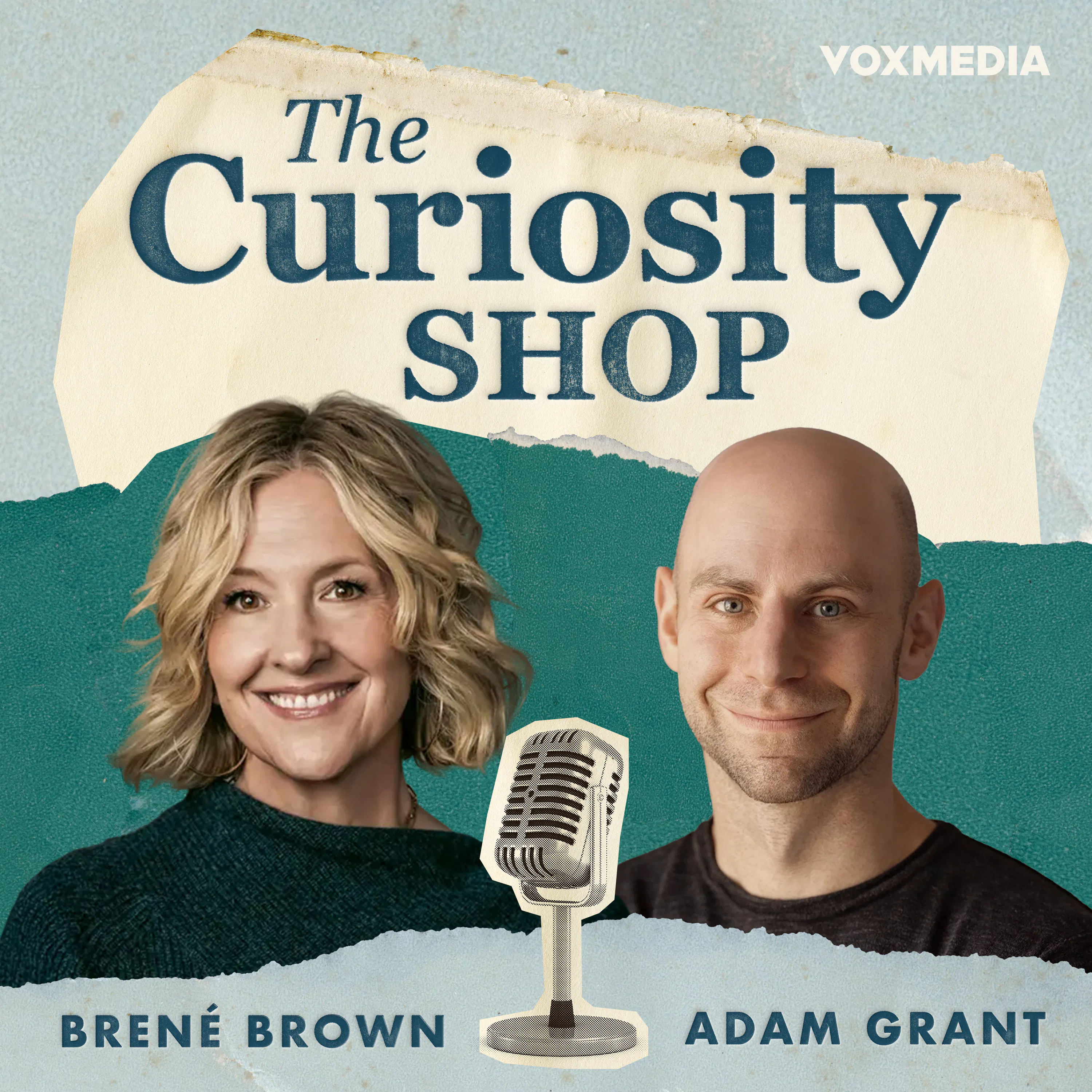
Brené and Adam on What They Will Never Agree On
At a Glance
The transcript is available, and the chapter summary is still being generated.
Show Notes
Transcript
Adobe Acrobat, your new foundation. Use PDF Spaces to generate a presentation. Grab your docs, your permits, your moose. AI levels of your bitch gets it in a groove. Choose a template with your timeless coo. Come on now, Let's flex those tools. Draft design, deliver, make it sing. AI builds the deck so you can build that thing. Do that, do that, do that with Acrobat. Learn more at adobe.com slash do that with Acrobat. When you use the trusted investing and savings app Betterment to help grow your money automatically, you have more time for new niche hobbies like collecting miniatures. The joy that brings helps you sleep better at night and even motivates you to always use your PM moisturizer. Now you've got a dewy glow and a sense of balance to match. Not worrying where your money is growing. That's the Betterment effect. Get started today at betterment.com. Investing involves risk. Performance not guaranteed. Support for this show comes from Odoo. Running a business is hard enough, so why make it harder with a dozen different apps that don't talk to each other? Introducing Odoo. It's the only business software you'll ever need. It's an all in one fully integrated platform that makes your work easier CRM, accounting, inventory, ecommerce, and more. And the best part? ODOO replaces multiple expensive platforms for a fraction of the cost. That's why over thousands of businesses have made the switch. So why not you? Try Odoo for free at odoo.com. That's odoo.com. Welcome to The Curiosity Shop. A show from the Fox Media Podcast Network. Hi, everybody. Welcome to The Curiosity Shop. I'm Brene Brown. And I'm Adam Grant. We're glad you're here. We're here. I'm glad we're here. I'm glad we're here. I'm
shocked we're here. Really surprising. We did it. Well, we're doing it. Well, yeah, yeah, yeah. Let's not get too excited. Two things that I think we should talk about today for our first podcast, Maiden Voyage. One, how we got here and almost didn't get here. Are you sure we want to go there? I think we should. And if this absolutely goes to hell, what our best predictions are about why it'll go to hell. How about that? I definitely look forward to that one. Yeah. So let's jump in. Okay, before we do that, I want to take a quick moment to thank our launch sponsors. We have SaaS, Powering Better Decisions with Data and AI. You can learn more at saas.com. That's sas.com. And if you're looking for a partner in design and productivity, you can also check out our other launch sponsor, which is Canva. You can learn more at canva.com. I'm self teaching myself Canva. It's really fun. If you can't find me some time, it's because I'm trying to make cool things. That's canva.com. And thank y'all both for being launch sponsors. That's We're obviously thrilled to have them on board, and you'll get to hear more about them as we go. Yeah, let's do it. So tell the story about how we first encountered each other. Well, I remember meeting in a green room backstage before an event that we were both speaking at, and we probably chatted for five minutes. This was before our desktop? Yeah. Yeah, this was a decade ago, probably. Oh, wow. Okay. I don't remember. Maybe, no, it was longer. I think it was 2013, 2014. What it yeah, I don't remember. I think we were in Arizona, and we met backstage, or no, it was a green room, And I think we chatted for five minutes, and that was the end of it. And clearly left a bad impression because you took me down in your online article. That not my Yeah, go ahead. Go ahead. Clearly, that was not a good meeting. This was not a good meeting, folks. I thought the meeting was fine. Okay. So let's talk about I actually how left it feeling like I was awkward
because I felt like I knew who you were and you didn't know who I was. I would be surprised if I didn't know who you were in 2013. I don't know. I just walked in and introduced myself. I don't know if she knows who I am, and I don't know if I should introduce myself as if she does or doesn't and didn't know what to do with that. So you know, it's probably because when I'm in a green room, I'm locked in, and that's probably why I'm locked in, because I'm praying. To whom? God. I am praying. I have a prayer that I say every time before I speak. Before a speech? Before a talk or anything. Really? Oh, yeah. Oh. Yeah. Okay. So I had no idea. So I was trampling on your prayer. No, no, no, you weren't trampling, but I'm probably locked in in a green room. Okay. And maybe back then even more so. I believe that. Yeah. But, you know, other than just not being sure how the interaction went, I didn't really think about it. So then let's talk about what happens next. Okay. Then I was writing an article about what I consider problematic advice for people at work, which is be yourself. Agreed. And I was looking, well, I wrote the article basically just trying to capture some evidence about how people who are too obsessed with being themselves end up making bad impressions and getting worse performance reviews and not getting promoted. And I finished the draft of the article and my editor said, You need a definition of authenticity. And I started looking up definitions, and you had the best one by far, by far. I mean, nailed it in a sentence. And I thought, This is it. And I thought it was a shout out. Like, Hey, you know, Brene has done the best work on authenticity. Let me quote her. What I did not do, and I regret having not done it, was read the rest of the work and understand your definition and context, because
I think I would have framed the article very differently, but it didn't cross my mind. I thought it was, Hey, Renee's done great work on authenticity, here's how she defines it, and here's how the advice to be yourself can get you in trouble. And that is not how it came across to you, I think, because I woke up the next morning and my social channels, my email, even some texts, all of it was blowing up saying, Brene Brown just smacked you down. And I was like, what? What? I I was shocked. You were not happy. But didn't let me let's find it. We should have prepped for this. What is the what is the let's see. You're looking for the title? Yes. I did not write the headline. No. Let's go ahead. Go ahead tell folks the title. I think the title was Unless Be Yourself is Terrible Advice. And then but where was the part I'm in the LinkedIn. What was the part about me? No. There was no. No. No. We should we should look. Hold on. Let's look. This is the LinkedIn. By the way, we've we've never really talked about this. No. We've never talked about it. No. I think you around it. No. I think what happened was what year was that? 2016. '20 that one. It's not this one? It's the Oprah one. Go back up. Hold on. We're looking right here. That's it. Yeah. Right there. January 2016. Okay. Yes. Yeah. So it was a smackdown of authenticity. I didn't mean it for it to be a smackdown of authenticity, though, right? I was trying to say
the be yourself advice as a way of expressing authenticity. But I actually believe that authenticity this a is wild thing that we ended up here. We not plan for this. Every time we sit down, this happens. Like, you have no idea how many times we've scripted what we're going to say, and it never works. Here's the thing that's frustrating to me about the perception of my work. Be vulnerable is the takeaway, but no one reads the next three sentences, which says vulnerability minus boundaries is inappropriate disclosure. Right. People read the definition of authenticity, but built into the definition of authenticity is boundaries. Yep. Boundaries. The cost people have look, I've worked in unsafe places. Like, literally, my first boss out of my MSW program threw a glass paperweight at me. Like, no, I have worked in Are you serious? Oh, yes. I have worked in really tumultuous- And let me tell you, like, I graduated from high school in 1983. I was two. Yeah. Fuck off. When, for me, sexual harassment was the price of entry for work. Yeah. I'm so sorry. No, yeah, but it's for most women my age, we The whole idea that I would tell people, without any boundaries, be vulnerable, read the rest of it. Don't weaponize the first line if you don't understand the second. I can't fix the fact that people don't read the whole thing and leave with a single message. Any message taken out of context is dangerous. When I was a young academic
I was authentic by my definition, which was I was brave, I was boundaried, I trusted my instinct about who to trust with, you know, things that I wanted to share and not share. So, the whole thing is that no one talks about the emotional weight of not being authentic. You know, so I think authenticity is a very complex thing that includes being boundaried and building internal systems where you count on yourself intuitively to trust when you can share and what you can share and with whom. And I'm completely on board with that and clearly did not capture that in this piece where I quoted you out of context. Yeah. And so I think that So when I read that, probably my ire towards you is that right? The right word? Yeah, like my Oh, I think it was stronger than ire. You do? I mean, look at some of the sentences you wrote in your response. Oh, but people complimented us on our back and forth, right? People were like, Wow, this is how more people should argue this way. But I think we debated. I was absolutely pissed because I think you represented a larger wholesale issue with the weaponization of work. That and it's not just my work. You know, we were with Astaire Perel last night because, you know, coming off a South by Southwest event. The hardest, one of the most difficult things about emotional resonance, when you write with emotional resonance emotionally resonant language, is it succeeds in doing the thing the writer wants, which is to internalize it and make it your own. It's emotionally resonant. It finds a compartment in your heart where it can live. It gets cozy. It gets a blanket. It snuggles into the sofa in your heart and thinks, yeah. This speaks to me, this is true, then you make it your own,
and then you regurgitate it through your own lens. And that's why people are like, psychological safety. So basically what Amy Edmondson is telling people is if it doesn't feel comfortable, then it's okay to say you're unsafe. No, she never said that. The opposite of She's a hardcore performance researcher, Right? And so I think you and it didn't help that you were a dude. Oh, wait. So I got stereotyped as one of those men. Yes. That you yes. I think my initial reaction I don't think I had the language scientist jerk. Yeah. Mansplaining my work and taking it out of context. So then I was like, I'm done with you. I was just like, I can't. And, God, in a way It was more than that, wasn't it? No, I don't think so, because I never because we didn't talk for four years that time. But we had never talked before that. That's true. Yeah. So it's not like we were friends and I broke our friendship. No, but we I mean, I wrote a pretty strongly worded rebuttal, and then you responded again. And then we just, that was the end of it. Yeah, and I remember somebody, I don't know, was Seth Godin or someone was like, Hey, y'all, there's a desktop on LinkedIn. I was like, Oh, please. But yeah. I I just wasn't doing it. But I have to tell you that it was probably a disproportional response. You think? I'm sorry about that, yeah. Oh, thank you. Well, I'm sorry that I failed to read your definition in context because I would have written really differently about your work and how it actually is the solution to the problem with peer self advice, not part of the problem. Yeah, because I think people who understand my work know that
my bottom line is be yourself with people who earn the right to see yourself. Share your story with people who've earned the right to hear your story. Wait, say that again. Be yourself with people who've earned the right to see yourself, you know, to see you, and share your story with people who've earned the right to hear your story, and with people with whom you've built a relationship that can bear the weight of the story. You know, that's like it's so This is really interesting because people, this is so interesting, because people also say, Wow, you're telling people to take their armor off at work. And I said, No, actually, when we do a Dare to Lead intervention, the reason why a lot of CEOs, after the first meeting with me, say I'm not working with you, is if you want us to come and do the work, I'm happy to do that. We're going to start by identifying the people with the least formal, the least amount of formal power, and the least amount of proximity to power, and then we're going start with one question: Why is armor required or rewarded here? And if you're willing to hear what information we collect from that process, you're a great fit for this work. If you don't want to know what you and other leaders are doing to make armor required and rewarded here, you're not going like working with me. So powerful. Yeah. So very few people make it through that litmus test because most people are like and then then this you can imagine if I'm working with the CEO that says, I want to know. Yeah. Because the armor is not only killing them, it's killing innovation, it's killing trust, and it's killing performance. It's shocking to me that there are leaders who wouldn't want to know. Oh, the majority. I mean, one that I think long term is a choice to fail. It is a choice to fail, but it is a choice of self protection and ego over winning. And secondly, I mean, I think it's just morally irresponsible to not care about the impact of other This where we go so wrong, because I'm like, but isn't the protection of power and privilege morally irresponsible?
Yeah. It is. Yeah. So so that's where that's where this lives. So I think I was and I have to say it was an embryonic moment in my career when this happened that I was just starting to see people bubbling up, taking the work out of context, and it was at a larger scale than I could whack a mole down. Because at first I was just responding to every tweet, every everything. No. No. No. That's not this. You missed this part. No. No. No. This and then there it is in the New York Times. You know? And I'm like, shit. Well, I look. I think you can say your response was disproportionate, but I'm the one who caused the response in the first place with what I wrote. And being careful in my writing and being respectful of other people's work are core priorities for me. And I'm sorry that I failed to live up to those standards. I think a couple of things are, you know, are occurring to me as we talk this through It's strange that we've never talked about this. I for think we've talked about We've never, we've walked around it. We've never walked into it. No. And I'm trying to figure out why, which I want to talk about. But I think one, you know, one thing that hit me after I got some distance from your response was, what I should have said, and what I actually think we agree on, is that authenticity without empathy is selfish. That is not just about saying, Well, this is who I am. Let me express myself. But also, I need to do that in ways that show regard for other people's values and well-being. Yes, I think empathy, I think authenticity without empathy and boundaries fails to be authenticity. And I think authenticity should be in service of connection. So I think it's very difficult from a work perspective
to be authentic in an environment where conversations about power and identity are not okay. Yeah. Yeah. I think, I mean, it's remarkable how aligned we could Yeah. Be on Yeah. So why why have we never talked about this? Because I came on to that thinking, I will never talk to this person again. Same. Oh, for sure. Right. By design. Yeah. I mean, just yeah. No. I I don't know. So for the over four years, over the course of the four years, several people came to me and said, I know you and Adam had, like, a real disagreement. It was pretty public. I think you would weirdly get along. And- and it's not that they said, I weirdly think you would get along. They said, I think you would weirdly get along, which we weirdly get along. Sometimes. Yeah, sometimes. I mean, we think we always get along. I mean, there's been hiccups, but they're not hiccups. I don't want to there's been moments of frustration and then repair, frustration on both sides. I I don't know. We I just wasn't interested because we've never talked about this before. Because I think in the four years that followed the article, this became one of the heaviest and hardest things in my life, this kind of misuse and weaponization of my work. And I was an avatar of that. And you were an avatar you were an early avatar of that. Yeah. And so I think I just was like and it was coming in. It felt sandwiching for me because on the one side, I got you know, you're not you're not understanding what it's like for some people that are not in your position,
what it means to be vulnerable, and I said, know, God. And then on the other side, I remember I got a revise and resubmit on an article that said you've oversampled, especially black women. And so, yeah, and so it was forty eight percent of one of my samples. But I think it was like, because that's who's being targeted right now. And so it's not an oversample. It's a you're an understupid. I mean, I just had this bad reaction. So I think I just was disinterested. The hard thing for me that felt misaligned is I was reading all of your work. I was reading yours too. Yeah. I was reading your work, highlighting your work, challenging myself with your work. I was respecting and appreciating your work. So then I get the call four years later from you. Do you want to talk about that? I don't know. Do Yeah, you can just go ahead. You called for You asked me for a favor. I asked for help. Yeah. I was Well, yeah, I was I mean, I was reading and learning so much from your work and watching your talks. And every the other thing that happened was everywhere I went, you had spoken. Same. I kept hearing. I I actually I have a I have two questions I always ask when I when I'm either speaking at an event or visiting an organization. One is what can I do better? The other is who's the person who's had the most impact? And every single place I went, when I asked who has most helped your organization or your people, the answer was Brene Brown. And at first, was like, damn it. Like, I hate that. This is terrible. Newman. Exactly. Newman. It was such a Seinfeld moment for me. Newman. And then it happened enough times, and I had been internalizing much more of your work, and I'd found myself quoting you, saying, as Brene Brown says, Clear is kind. And I think I begrudgingly had to admit that there was value in your work, and I find it really hard to fully separate the art from the artist. Same. I think your values are infused in
what you create. And so I started coming around to the idea, this person has a lot to contribute. She probably has a lot of virtues. And yeah, then I was, during COVID, I was working with a women's sports team and having a hard time getting them to engage with some of the research and ideas that I thought would help them. And I decided to create a little speaker series, because nobody could go anywhere Oh yeah, yeah. So I said, Let's do this virtually. I'll bring in speakers. Who do you want? And the number one request was Brene Brown. And I and no one. And I thought, what do I have to lose? Worst that happens is she still hates me, and we don't talk. We already don't talk. She probably already hates me. And I was so surprised. I I reached out to you, and you said yes immediately by email. You responded to an email. Did respond to very unlikely. And and I remember you showing up and just one, you know, just imparting so much wisdom to the team, and two, making it clear that you wanted to help even somebody you didn't like. Like, who does that? Yeah. Because I felt hypocritical because I think you probably that email caught me right in the middle of reading one of your books. And I think I was talking to my kids about your work too, because I thought it was really helpful. And so I was just like, this is so- this is just stupid. I don't know what word- I mean, like life is too hard at this point, because we were in the middle of COVID. Stuff was hard. I thought it was really generous to reach out to me. I mean, it's interesting. The first time we did a DARE to Lead intervention was at the Gates Foundation, And we asked that was the first place we asked this group
of leaders this question, and we've since asked over 10,000 leaders: What is the thing that your direct reports do that build trust for you? Like, someone's reporting to you, what's a behavior they engage in? And I everyone always thinks it's gonna be reliability, like, you can dependability or reliability. And the number one thing is always they ask for help. When someone who reports to me asks for help, my trust for them skyrockets. So I think when you ask for help, I kind of felt like this is, first of all, hypocritical internally. Does it make sense to me? He can't be the avatar for a general frustration I had, because I am the avatar for so many people's frustration, and that's so unfair and hurtful. And so I was like, this is a great opportunity. Wow. Look But at we've never talked about this. It's so weird. Well, okay. So a couple of things. One, you're reminding me of a classic paper by Jecker and Landy, 1965. Fact check that later. The paper is about liking a person as a function of doing a favor for them, and how when you are asked for help, when you help the person, if you weren't forced or obligated to do it, you come away thinking, Well, I must care about them or like them. Otherwise, why in the world was I doing this? God, that's interesting. Obviously did not cross my mind. I was just desperate to try to get through to this team when I reached out to you. I have to tell you, that was a tough gig. It was definitely challenging. And it was a Hail Mary pass to you, which you kindly caught. Ran down the field and boom. Touchdown, Renee Brown. No, I didn't actually. I actually experienced that. I didn't care as much of the outcome of how impactful our conversation was. That was not my goal for the interaction. My goal for the interaction was more repair with you and connection and just kind of build something. Wow. Yeah. Because it wasn't the first time I'd worked with that specific group of people, you know,
or at least in individual capacity, and I knew it was going be tough. Yeah. Well, then it was extra generous of you to take it on, given But what you were walking I think it's I remember being unsure at the time. We talked probably for five minutes before we went on the virtual stage. Yeah. And I wasn't sure if I should apologize and try to repair the relationship then, or if just, it felt like there wasn't enough time. And I decided instead just to show my genuine appreciation for you being willing to do this you know, help And me and help I think, I'm curious now, if I had apologized then, would it have played out differently than just kind of getting to know each other on a different level through working a little together? I think I was very hopeful that this would never come up again. Was just like You didn't want to talk about it? No. I didn't. I don't think I wanted to talk about it then. I was like, let's just lock in and help this team. Like, this is You were in task mode. Yeah. I was in task mode. And I was also like, let's just move on. And I don't think we would have I don't know that we would have I don't know that it would have been helpful in that. It's almost like me not remembering that I met you in the Green Room. Like, when I go, I have my list of questions before I do something like you have your list of questions. My questions are: What's a home run look like? What's the greatest lift I could do for you right now? If, you know, and sometimes someone will say, If you could make a connection between these two things, it'd be really helpful. If you could do this or this. And then sometimes I have to say, I actually don't believe that's true, so I won't be able to do that next time. You do not actually want what you think you want. I don't you think you need, but I tell you what I think I could do that might be more helpful. Exactly. And if that's what you need, oh, I'm not your right person. Like yeah. So That's such an interesting Jerry Maguire moment. Like, help me help you. Yeah. Help me help you.
And zero chance that I'm gonna do your bidding for something. And and, yeah, it's not gonna work like that. Support for this show comes from Odoo. Running a business is hard enough, so why make it harder with a dozen different apps that don't talk to each other? Introducing Odoo. It's the only business software you'll ever need. It's an all in one fully integrated platform that makes your work easier. CRM, accounting, inventory, ecommerce, and more. And the best part? Odoo replaces multiple expensive platforms for a fraction of the cost. That's why over thousands of businesses have made the switch. So why not you? Try Odoo for free at odoo.com. That's odoo.com. Okay. So you wanted to move forward? So I just wanted to move forward. That's okay. That's helpful to know. I felt like it was an elephant in the room not talking about it. And I think we, I think our next interaction then was months later when you invited me onto your podcast, which was shocked when you did. And I think I probably just said, you know, I regretted the way that I, you know, I captured your work in that article, and I, you know, I don't think we aired it, but I just said, you know, I committed to making that right moving forward. And that was the feeling we haven't talked about it since. I'm going to tell you one thing that I think is weird that is weirdly surprising about you that I've learned in the last couple I of don't think I've ever been like, I think the shtick that people think about us who know us together or have been working on the podcast is like, I'm the emotions person, you're the data person. I'm the left brain, you're the right brain. Reverse. Yeah. Oh, wait, no. I'm the right brain, you left brain. Yeah. I'm qualitative, you're quantitative, you know, you're empirical evidence, I'm lived experience,
you know, with empirical rising, because that's just grounded theory. But I will say one of the things I found really surprising is I don't think I've ever been across from someone who has- that I have experienced taking more full accountability in a repair situation and issuing a more thoughtful apology than you. Thank you. That has been a very big learning for me about what I could do better. Really? Yeah. And so I think at the top of that podcast, we we I chose not to air it. They actually they asked asked me, like, wow. That was so beautiful. Do you wanna put this include this on the podcast? Because we were already recording. Wow. Yeah. And I said no. Was personal. Do you still have it? I doubt it. I doubt it. I I don't know. I don't I don't know. Do we keep those things? I don't know. I don't know. I don't know. I doubt it. No. I'm I'm curious to listen to it and learn from it. Yeah. No. I think it was well, you mean your own apology? Yeah. Oh, I've got one in in another one from you in writing. More recent. Very recent. That that was extremely recent. Yeah. That Which you have not responded to. Because we did over the phone. I know. But I wanted to document it to make it really clear that I understood the mistake I made and I was gonna correct it moving forward. And I also wanted you to have it to share with your team because I think I left them feeling a little devalued. But you reached out to them individually and Oh, I did. But okay. Well And I didn't even know who was affected. Okay. Well, I just wanna say that I think your repair and apology Harriet Lerner, who I did this podcast with on apologizing, she's just one of the greatest mentors and teachers, would be like, damn, y'all. This is this is a masterclass in repair and apology. Well, thank you. I I appreciate that. Where does that come from? I I think it comes from comes from two places. I
I grew up in an environment where people didn't know how to repair. And I just, I don't know, I don't know, actually, I'm not, I'm to make sense of this. I think the short version is, let me try this again, I think there's something about being a child of divorce that led me to say, I'm gonna be the peacemaker. I'm gonna make sure everyone always gets along. And so when I learn, like, one of my core values is kindness and generosity, and you can't always make sure that your behavior lands the way you want it to. And so if you don't get good at righting your wrongs, then you're gonna have a lot of damaged relationships. And so I think that was in the background. I think I struggled early on. I really like being right. You know this about me. Yeah. And admitting that I was wrong is, it's really hard for me. When I struggle with something like that, I feel like I have to overcorrect in order to build the skill that I'm trying to build. And so, actually, it's something I started practicing. Allison would give me a hard time because, you know, I didn't want to kind of admit that I was wrong in an argument, and then the next day I would have to very sheepishly come to her and do my little Happy Gilmore routine. Do you know this scene? No. Okay. So I'd come in and I'd be like, You were right. I was wrong. You're smart. I'm stupid. Oh, no. You're good looking. I'm not attractive. Oh, no. It's a scene right out of Got it. The Go And we'd both start cracking up. Yeah. And I had to do that a bunch of times to get used to saying, You were right, I was wrong, and being okay with that.
I'm still I can be a good person and admit that I did a bad thing. I can be a smart person still and admit that I got something wrong. Like, I don't have to get an A plus on everything. That was a hard thing for me to learn. And once I learned it, I felt like this is something I have to get good at if I care about people and I care about relationships. You're not a therapist, but thank you for inviting me to your- No, I am definitely not. Another thing people get wrong about me, for sure, I have a therapist, too, couples and individual. I'm just blown away by the application of your rigor, the same application of your rigor around organizational and behavioral science, to becoming a better person. And think I've just had, like, a big learning, which happens every time we talk about hard things, I think, which is it's not hard for me to be wrong at all. Oh, I want to know more about how you've Yeah. Got I don't think I repair and apologize as well as you do. Because, like, I'm going get better at that. I'm going to work on that. Because it's an interesting experience. I'm like, I am wrong. That's so great. Like, I take a lot of, like, I take a lot of comfort in knowing that I'm comfortable being wrong. Like, I like the fact- I like that about me. Like, I can own stuff very quickly. But I think sometimes I don't look at the damage that being wrong did. What happened? Maybe because that's the feeling part of it that I don't like. And so I can definitely cognitively be like, oh, I was so wrong. You're right. But,
and I apologize, but your repairs are very specific. They feel they don't let you or me off the hook in terms of accepting them. You name very much, I apologize for this. I'm wondering if this left people feeling like this. That was not my intention. There was a gap between my intention and my impact. I see that. I apologize for it. I own it. I will course correct. I mean, read the research on how to make amends, and then some of This what I'm saying. This is what I'm saying. Like, I just feel like everybody in the room, like masterclass and apologizing and repair, everybody's like, Wow. Yeah, it's impressive, so thank you. Thank you for that. I think it's Okay, so I to go back to authenticity for a second. Yeah. You said earlier, I was just thinking about this actually in the context of apologizing, I think when people put on armor I think there are workplaces and families where people can't apologize because apologizing comes Weakness. Across as Yeah. Exactly. For sure. My family. And Yeah. Go ahead. Yeah. And I just look at that, and I think if you have wronged somebody or hurt someone or even done something that, you know, just had an impact that was different than what you meant. Refusing to apologize is not a sign of strength. It's a sign of narcissism. It's so interesting how we I think one thing we share in common is I do think about the data when I think about who I want to be. Like, I do think about research when think about and so you do too, obviously, yeah. I do- I don't know that it's a form- I don't know that I agree with the narcissism
part. I think that it can be shame to apologize because I think when you're raised in a shame bound family that there's no difference between I did something wrong and I am wrong. I'm a bad person, not I did a bad thing. So you never get the adaptive effects of guilt? You don't get the adaptive effects of, I am a good person who made a choice that was hurtful to other people, I need to repair and make a different choice moving forward. You get a, I am not a good person, I am not worthy of love and belonging. So I think for a lot of people, which is interesting, in shame bound families, I think there what the research shows us is there are more disconnections and disruptions and ruptures and less apologizing for them. Wow. So I think and I think in my family, again, fifth generation Texan, you know? Culture of honor. Culture of honor and shame. Think of shame as the flip side of As the flip side of honor. Yeah. Yeah. It's actually not the flip side of honor. Shame and honor live on the same side of the coin. Think Because they're both excessively image focused? Managing self perception and duty over commitment. Wow. Yeah. I mean, think in shame bound families, there's a duty to not talk about certain things. There's a duty of there's duty. And not and duty is very different than commitment. Because duty is externally imposed and Yes. And commitment is internally chosen and intrinsic? Yes, exactly. And duty, the and duty, if you make a mistake, it's not a failure of choice or behavior, it's a failure of your humanity. Wow. Yeah. Okay. So connect this back to authenticity now. You were saying earlier that we don't talk enough about the price people pay for having to
not bring their true selves to work or to home. Well, yeah, I think compart I mean, I think there's a lot of interesting research on, you know, switching, code switching. I think there's a lot of really important work done in that area already. But the price unfortunately is not just emotional and cognitive, the physical price of that kind of of that kind of having to be different people all is the so high. Well, I was thinking in particular about Patricia Hewland's work on facades of conformity and how when you feel like you have to put on a mask in order to succeed professionally, you see then higher rates of burnout, you see people becoming alienated from themselves, you see extreme stress. I was starting to think that's what happens in shame bound families too. Oh, for sure. I mean You go to Thanksgiving dinner, and you have to you're you're basically an actor playing a role. And what toll does that take? Yeah. I mean, it's it's really that's why I think I was gonna try to pull up. Let me pull up and see what the definition let's see. Oh god. I'm scared to look at it, y'all. I may not agree with my own definition anymore. Do you ever feel like that? Yes. And then and then I think, wait a minute. This is a great learning opportunity because Oh, do you? Yeah. I I think about Danny Kahneman all the time who who said to me, when I realized I was wrong, it means I am now less wrong than I was before. I've learned something. Great. I like that. I think, oh, shit. That's what I think. Let's see. And we we need to get to our
what what what does this look like if it goes wrong? Yeah. Do we have time for that? Should we do that on the next an episode for episode two. Because I I really wanna go through so we are both big fans of Wait. Don't do it now. Because if we're gonna do it in episode two, do it in two. Okay. Can't even find the definition, which is really We can edit that out. Yeah. Oh, yeah. No, it's being one's true self and setting boundaries to protect one's true self. So like I think it's both. The courage to be real, letting go of perfectionism. It's a daily practice, it's collection of choices. So I think it's still what I think. You're rarely going to find me not having boundaries attached to some definition. You know? I think that's so important. Yeah. It's usually left out. It is, and I left it out. My mistake. But I think we do too sometimes in our own work. Well, I mean, it's hard to communicate in shorthand, right? It is. Capturing all the nuance in a few words is always a challenge. It's really interesting that you say that because we have a writer, like, when we do podcasts that why are you laughing already? Just keep going. Yeah. That we have to approve all clips. Because right before I went off social media for almost a year, if I saw myself come up in a feed, in my own feed, which is a nightmare, do you ever see yourself come up when you're scrolling and you're like, shit. Oh, why am I there? Yeah, why am I there? But I think the thing I hated about it the most is how people were clipping me to seem so certain. And eliminating all of the pauses and all of the All of complexity. And they they would ask me a question like, you know, do does the blue jay call, you know, resemble the call of a red bird? And I'd be like, it's a really good question. I'm not sure. In
my experience, which is limited, they're very different. And then the answer would be like, does a blue jay then they're very different. Like and I was like, god. Like, what about the part where I was like, I'm unsure. You know, like, I don't know. And then the part behind it, it says, but I don't really I'm not a birder, so you should really ask a birder. Like And that's all added to Yeah. Oh, sucks. That's why I just went off social media because I was like, I don't even trust me in these things. The advice I first of all, I hate giving advice, but just what what does the research show, what am I learning, what's worked in my life, I I will share. But, like, don't trust what's coming out of my mouth when it's been clipped like that. Okay. So no one should clip the Curiosity Shop out of context. No. I mean, I hope you don't, but, I mean, you're going to. What do you do? I think you hope that people will engage with the long form and that the short form is, it's a teaser. It's not the whole concept. Not the whole idea. Yeah. And it's not even the teaser. It's like a I don't know. It's, yeah. Mean It's dessert, but don't skip the meal. Yeah. Maybe. Or it's part it's it's like it's the plate that holds the ideas that you you've clipped the plate, but not shared the real ideas that are on the plate. Dumb. Yeah. But I also think we have a responsibility to take complex research and distill it in a way where people can, you know, in short time, take an idea and say, Oh, I never thought about that. Let me now see if, you know, if that leads to a change in my experience, my choices, my behaviors. I disagree. I'm all for that. Really? Yes. Well, I think we have a harder job, which is to communicate complexity through story and analogy and metaphor
that makes it understandable without reducing its complexity. Oliver Wendell Holmes. You know this is one of my favorite quotes, right? No. Okay, so Holmes said something to the effect of, for the, he said, let me make sure I captured this right. He said something like, you can wait, no, fact check me after a minute. I'm gonna, yeah, yeah. Okay, The way I remember the quote is he said, For the simplicity on this side of complexity, I wouldn't give a fig, but for the simplicity on the other side of complexity, I would give anything. I think that's exactly right. Here it is right here. What does it say? Okay, for the simplicity on this side of complexity, I wouldn't give you a fig. But for the simplicity on the other side of complexity, for that, I would give you anything I have. Pretty close. Okay. So What does that mean? Well, I think about that as the difference. For simplicity on this side of complexity You're drawn, aren't you? No. I'm not thinking about that in my mind. For sure. But yeah. Well, I think that for me, the distinction there is there's this difference between ignorant simplicity and elegant simplicity. Oh, yeah. Ignorant simplicity is naive, and it's missing critical information. Elegant simplicity is capturing the nuance in few words or in a really well drawn two by two diagram. But that's so hard. It is really hard, but when you do it, it's really sticky. Spring is starting at The Home Depot, and we're bringing you low prices guaranteed so you can wake up your yard this season. Shape up your lawn with top brand outdoor power tools like this Ryobi 40 volt mower with up to fifty minutes of run time. Bring in a splash of color with spring blooms and fresh plants from The Home Depot garden center. Then refresh your garden beds and keep them clear of weeds with Vigoro mulch, free bags for $10. Start your spring with low prices guaranteed only at The Home Depot. Exclusion supplies. See homedepot.com/pricematch for details. Okay. I'm gonna share I'm gonna share one of my favorite quotes. We can end here, and we can take our postmortem to another episode because I think we should do it. I think it's interesting.
This is one of my favorite quotes, and this is weird. I'm looking at it because I have it on a screenshot. If I could communicate with you in screenshots, that would be okay. These are all haircuts, and they're all the exact same haircuts. Are you picking on my hair? No. Oh my god. No. That's funny, though. You got a good noggin. Can I say that? Am I allowed to say that? I don't know. Are you? I don't know. I think you have a nice noggin. Well, thank you. Okay. I don't know where this I prefer the apology compliment for the record. That's a bad compliment acceptor. You are the worst. I'm horrible at that. Yeah. I I think I did okay today, though, on it. You did. I was trying to find this Fight you or self deprecate. No, you didn't. That's growth. I'll take it. Yeah. And I actually that's I love it when you do that. I can't find my fun quote, but they're mostly, I just have, like, my kids playing. Oh, wait. I can read this one to you, but it's about the feast of Mary, mother of the church, and today's gospel reading. I will not share that. Gonna land for me. Yeah. Okay. Okay. Wait. So we're gonna we need to go to our our closing questions. I really am looking for my quote. Give me two seconds. There are me and Steve at prom. I can't and I don't even care. Like, we don't even have to cut this because this is what real life looks like. But I don't know where this quote is, but I'm going to say it and maybe you can you'll probably know it from memory, it's so irritating. It's a quote by a German philosopher that talks about the reason that complex simplicity is so rare is because it's mostly grossly misunderstood and requires some information to get. Like, I'm going find it put it the show notes, but like Please this do. By the way, I love the way you just reframed that as complex simplicity. That's a great paradox. But complex simplicity is why metaphor and story and analogy,
to say take something complex and then put it in a dimension that people understand. And poetry too. And this is why we're doing this show. The Curiosity Shop is all about trying to reach complex simplicity in a world that wants easy answers and quick fixes and consumes way too much snake oil. And, like, I wish to leave it there. We should thank Canva, and we should thank And SaaS. For being, kind of launch partner and sponsors with us. We're grateful for that. Okay, so this is exactly how this shit's going down. We have an agenda, and we get on a rabbit trail of research and But this is a good conversation. I really appreciated it. And I do really appreciate your commitment to being good at repair and apology. And I can say that it's had an impact on me. Oh, well, you. Not just on the receiving end of it, but getting better at doing it myself. Well, but that only happens because I've started to absorb some of your willingness to rumble and have difficult conversations that I was too much of a chicken to have for a lot of my life. And I just don't wanna be that person anymore. Yeah. Same. I'll work on it with you. Pinky? Thank you. Oh, look. He goes for the fist bump. Go for the pinky promise. Alright. First episode in the can. What do we think? We did it. I don't know. I I think we should do our zero to 10 rating and give each other a note on how we can do better next time. Okay. Now the zero to 10 is going to seem too Yeah. No, it's not just a zero to 10. What's something I and we can do better next time? I don't know how to use this. I don't either. That's why I didn't bring one. I don't know how to use this, but I want to be able to look up things and get But my maybe that's just like my magical thinking that that's what I want to do. But I do want to use it. But right now we're just staring at a picture of Hannah Waddingham because I really liked And her
I was wondering what skin products she was using. So this is not what's supposed to be up here. Focus, Bren. Focus. I know, I can't. I can't. Okay, what was your surprise- Okay, so this really is a surprise question, and I have mixed feelings about it already. I can tell. Yeah. Well, you know, I was just thinking about how we got here. And the preview, I guess, is we got here by disagreeing a lot. Yes. And so I was curious about what you think we'll never agree on. What do I think we will never agree on? Every time I have something that I don't think we're going to agree on, I think we end up agreeing to some degree. But I wonder if return to work. But under return to work is I'm wondering if we'll ever agree Oh, I think there's a lot of things we're never going agree on. Okay. I wonder if under some of the things that we'll never agree on will be fundamentally the conflict between research and lived experience that I think so many constructs and ideas and theories and strategies that come out of research Obviously, it's important, I think research is important. Wouldn't be here if Research professor who? Yeah, yeah, right, exactly. But there is I wonder if we'll agree upon whose responsibility it is to fill the gap between data and theory and then how that shit actually works out on the ground. Like, the gap between
the idea and the practical reality. We might never agree on that. -I think that's right. I think we'll never agree on it. Because I think we'll get into a return to work some we'll do an episode on return to work. Because I think where I get stuck is scholars who study it, and in order to study it and really have meaning, you have to have some controlled variables. Say, Oh, you don't need to be back at work if productivity is fine, blah, blah, blah. But then you have, like, Tim Cook who runs a company at a, what, trillion dollar valuation, who I'm pretty sure knows what he's doing in terms of a creative company, and was first to come out and say, Everybody back to work. And so there's a conflict between, sometimes I think, between research and lived experience that I wonder if we'll ever get there. I will always trust the evidence over experience, Right. If I have to I will always question where the experience or where the research stops being helpful because that's not people's lived experience. And then I don't think I'll attack the research, but I'll say it's hard, I think, in our line of work where I don't know. I think it's hard. I think well, I think this will be a place of struggle. I think so too. Yeah. Wait. What do you think? Well, I've I I thought of two. Okay. One is text versus email. Oh, you're just wrong. No. Email is better than text. It's asynchronous. You can do it on your own time. You can file things away. Texts are just never ending, and they grab your attention, and they take control of your life. We don't text the same then, maybe. Maybe not. Yeah. Nothing- okay, so here's this. Nothing comes in to my text.
Rarely do things come into my text that are not important. Email, I'm bombarded. 90% of the email, I have to filter to find you. Like, I have to filter to find you. And so and I get overwhelmed by it. And I guess maybe I also don't share my phone number very much with people. So if you're not, like, immediate in my life, you don't have my phone number. I don't either. But why don't you like, I love texting. We text all the time. You hate it? No, I mean, I don't hate texting with you. But we're actually having conversations about this show and learning from each other, right? Yeah. I think for me, most of the communication I have with other people would be so much easier to do by email, because I can sit down and do it when it's convenient, and then file it away and know where it is. Email is organized. I know exactly how many tasks I have to do. Text, it's it's a mess. I hate texting. God. Don't ever text me. No, that's funny, because we text all the time. Okay, what's the other thing? Okay, the other thing is much, much bigger. Faith. Faith? Faith. I don't, I don't, we've never talked about this before. No, we haven't, but you listed it. When I asked you what your two core values were, you said faith and courage. Yeah. And I was like, Oh, we are not gonna agree on this one. Why? I don't believe in anything that can't be proven, but I also don't disbelieve in anything that can't be disproven. Yeah, I don't believe in anything that can't be proven, okay? I don't Disbelieve in anything that can't be disproven. Oh, yeah. We'll disagree on that. Big time, right? Yeah. No. Yeah. Yeah. I
If it's a mystery that surpasses all human understanding, I'm for it. I am for being open to the possibility of Oh, never having faith in yeah, no. Yeah, we won't agree on that. But I think that's okay. Like, yeah, I think that's great. Yes. So I think it's a minor miracle that we've gotten to a place where we can be okay about disagreeing. Do you believe in miracles? No. Definitely not. Not a chance. You're You're just baiting me now. No. No. You walked right into it. I did. It wasn't complicated. No. That's fair. Okay. But I do think I mean, we started out not being okay with disagreeing at all, I think. Well, I was okay with disagreeing with you because you were wrong. What's something you think we can do better? I think I don't know. I really enjoyed the I love how free form our riffing Same. I always come away with new ideas. And, you know, I think one thing we can do more of Yeah. This isn't a better yet, but thing we can do more of is I found myself smiling every time you said, I don't agree with that. And that is We've come a long way from, I was so pissed off when you wrote that piece. Yeah, yeah. I was shaking. You know I rarely emote. It was an unusual experience for me. And so to be at a place now where you can say, I disagree. Yeah. And I'm not bothered. And I'm actually excited to learn. And also, you know, debate it a little bit. I love that. I think we can probably find a little bit more attention. Intellectually, Yeah. I don't think we should look for it. Okay. But. I mean, can have meta tension around that. I think This is such a great way to wrap it up. I think if we're both authentically who we are Have I earned the right to be authentic? Yes, you have. Have you earned the right to see my authenticity? Yeah. I think I I think I have. Six years ago, we were No. Were not. But I think if we're both just ourselves here,
the tension is going to be organic. Yeah. That's right. Because we just don't see the world the same way. Nope. But we see the same world, which is weird. And value the same things. And we value yeah. Mostly. Yeah. I think so. Let's do it. Welcome to the we're glad you're here. Come back. We'll still be on our first agenda from podcast one by the end of the season. Probably. Fun. Thank you. Thank you. The Curiosity Shop is produced by Bren Brown Education and Research Group and Granted Productions. You can subscribe to the Curiosity Shop on YouTube or follow in your favorite podcast app. We're part of the Vox Media Podcast Network. Discover more award winning shows at podcast.voxmedia.com.
Skim the episode first,
then decide if it is worth listening.
Sign up with Google in one click. 10 transcript credits included. No card needed.
Google sign-in · No credit card · 10 free transcript credits